
How Old Are Your Motorcycle Tires? Read the DOT Date Code Before Tread Misleads You
Learn how to find and read a motorcycle tire date code, why tread is not the whole story, and when tire age deserves a professional assessment.

Fact-checked against cited official documentation
Reviewed against Fact-checked against NHTSA guidance on tire aging and DOT TIN dates, plus MSF motorcycle tire and T-CLOCS pre-ride inspection resources..
Last updated September 24, 2026
A motorcycle tire can show usable-looking tread yet still deserve closer attention. Tire age is one part of the decision, alongside damage, pressure retention, wear pattern, storage history, riding use, and the replacement guidance from your motorcycle and tire manufacturers.
Start with the motorcycle owner’s manual and the tire manufacturer’s documentation for your exact fitment. If anything looks questionable, do not treat an internet rule of thumb as clearance to ride—have a qualified tire professional inspect it.
For a broader inspection routine, see the Motorcycle Maintenance Guide.
Why Tread Alone Cannot Tell the Whole Story
Tread depth matters, but it does not tell you when the tire was made or reveal every age-related change. NHTSA explains that tire aging involves changes to rubber and other tire components over time, influenced by use, storage, and environmental conditions. It also cautions that aging cannot be identified simply by looking at a tire. (nhtsa.gov)
That matters especially for motorcycles that accumulate few miles, spend long periods parked, or are bought used. A low-mileage tire may have plenty of tread remaining, but low mileage is not the same thing as a complete service history.
The Motorcycle Safety Foundation emphasizes that the front and rear tires provide the motorcycle’s traction contact patches, and that safe riding depends on appropriate selection, inspection, maintenance, and replacement when necessary. (msf-usa.org)
Find and Read the DOT Date Code
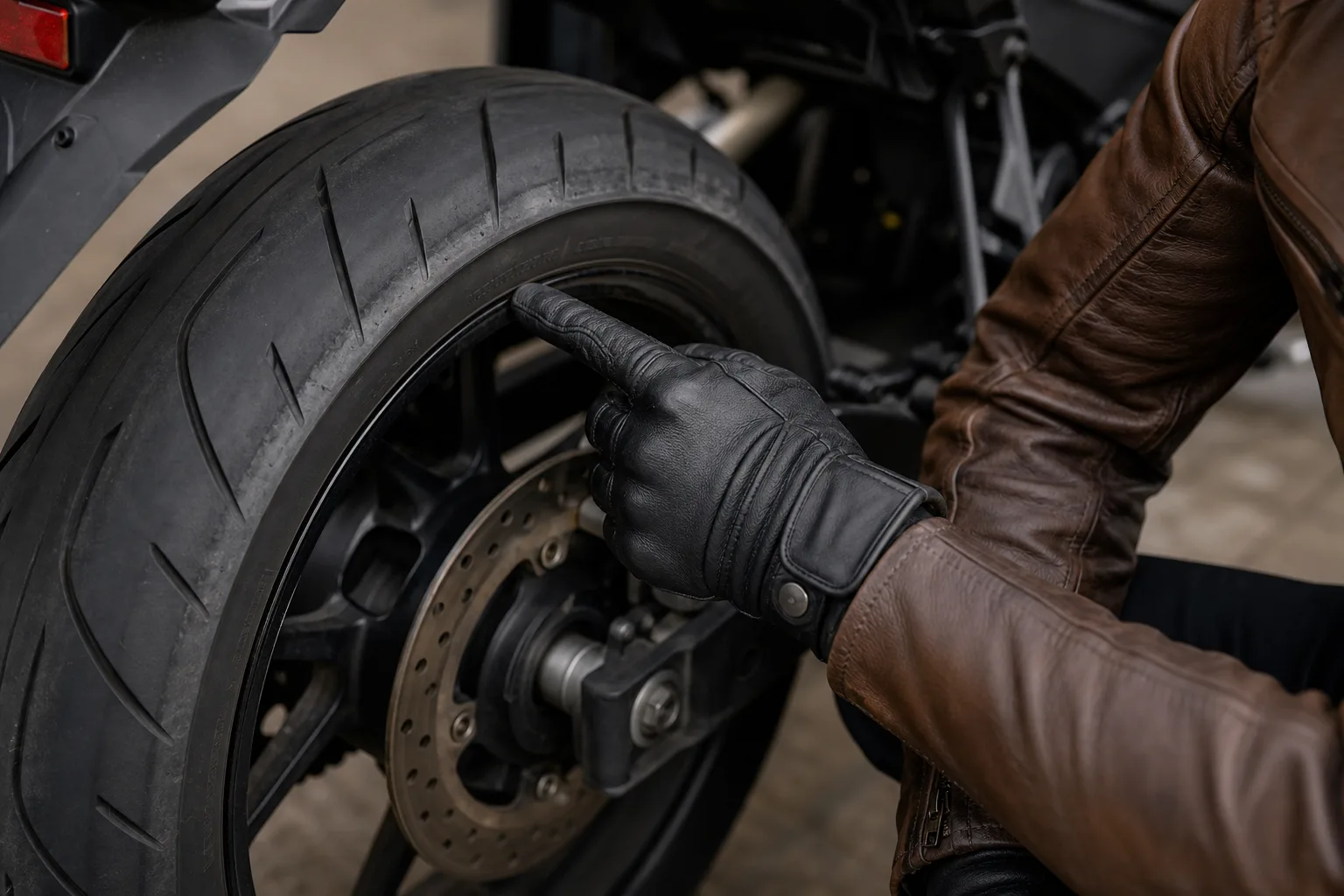
Look on the tire sidewall for the DOT Tire Identification Number (TIN). The final four digits identify the production week and year:
| Final four digits | Meaning | Example |
|---|---|---|
| First two digits | Week of manufacture | 03 = third week |
| Last two digits | Year of manufacture | 08 = 2008 |
| Full example | Week + year together | 0308 = third week of 2008 |
NHTSA notes that the complete TIN may not appear on both sides of the tire, so inspect both sidewalls if the date portion is not immediately visible. (nhtsa.gov)
Write down the code for both tires. They may not have been manufactured at the same time, especially if one was replaced after a puncture, crash damage, uneven wear, or a prior owner’s service visit.
The date code is a starting point—not a stand-alone pass/fail test. NHTSA says some vehicle and tire manufacturers recommend replacement at six to 10 years regardless of treadwear. Your tire maker and motorcycle maker may give more specific guidance, so follow the applicable documentation rather than assuming one age threshold fits every tire and riding situation. (nhtsa.gov)
Motorcycle Tire Age Checklist

Use this as a parked-bike review before relying on older or unfamiliar tires.
- Confirm the correct tire guidance. Check the motorcycle owner’s manual and the tire manufacturer’s material for approved size, load capability, speed capability, inflation guidance, and replacement advice.
- Read the DOT date code. Record the final four TIN digits for the front and rear tires.
- Consider the history. Note long storage periods, outdoor parking, high-heat or high-sun exposure, unknown ownership history, and low annual mileage.
- Inspect the whole tire. Look for cracks, cuts, bulges, embedded objects, unusual wear, and other visible damage.
- Check cold pressure. Use the motorcycle manufacturer’s specified cold inflation pressure for the current load and riding plan.
- Pay attention to changes. Escalate unexplained vibration, noise, handling changes, or a tire that will not maintain its specified pressure.
- Choose caution when uncertain. Pause riding and arrange a professional assessment rather than trying to judge structural condition from tread alone.
MSF’s T-CLOCS checklist supports examining tires for wear, weathering, bulges, embedded objects, and correct cold inflation pressure as part of a pre-ride inspection. (msf-usa.org)
When to Pause Riding and Get a Professional Opinion
Do not continue to evaluate an uncertain tire only by taking increasingly longer rides. Stop and seek qualified help if you find a bulge, cut, visible weathering, an embedded object, irregular wear, repeated pressure loss, or an unfamiliar vibration or noise.
NHTSA advises consumers to consider both a tire’s visual condition and changes in performance, including difficulty maintaining pressure, noise, and vibration. (nhtsa.gov) A tire professional can assess whether the tire should remain in service; they should also confirm that any replacement matches the motorcycle and its manufacturer requirements.
Storage is another reason to avoid easy conclusions. Sunlight, warm climates, poor storage, poor maintenance, and infrequent use can all contribute to tire aging, according to NHTSA. (nhtsa.gov) Keep a simple record of when you read each tire’s code, when you check condition, and what a professional recommends.
Combine age with condition and history
Calendar age is one input, not a stand-alone pass or fail result. A useful assessment combines the manufacturing date with storage, pressure history, load, heat exposure, impacts, repairs, chemical exposure, and visible condition. Much of that history may be unknown on a used motorcycle, which is important information to share with a tire professional.
Do not let healthy-looking tread erase other concerns. A low-mileage motorcycle may retain tread while time and storage conditions continue to affect the tire. A newer date code likewise does not excuse damage, pressure loss, incorrect fitment, or abnormal wear.
| Evidence to collect | What it helps answer | What it cannot prove alone |
|---|---|---|
| Full DOT/TIN and date code | Manufacturing identification and week/year | Present roadworthiness |
| Cold-pressure history | Whether inflation has been monitored | Absence of internal damage |
| Tread and sidewall photos | Visible wear, cracking, cuts, or deformation | Condition of hidden areas |
| Service or purchase record | Installation date, repairs, and known use | Complete storage and impact history |
| Model and tire specification | Whether size and load or speed requirements can be checked | Correct installation without inspection |
Inspect more than the four date digits
Locate the complete marking and inspect both sides where safely accessible. The date portion may appear on only one side. Do not crawl under an unstable motorcycle or improvise lifting equipment merely to photograph the code; a shop can help identify it safely.
Check the entire visible tire for embedded objects, cuts, cracking, bulges, uneven wear, exposed material, valve condition, and anything contacting the tire. Look at the wheel and confirm that the tire information matches the motorcycle documentation. If a marking is unclear, preserve a photo and ask a professional rather than guessing.
Keep a separate record for each tire
Note front or rear position, manufacturer and model, size and specification, full identification code, manufacturing date, installation date if known, mileage at installation, repairs, pressure checks, and inspection findings. Front and rear tires may have different histories even when they appear to match.
Update the record after a pressure-loss event, impact, puncture assessment, long storage period, or major load change. A sequence of observations is more useful than one photo because it can reveal recurring loss, changing wear, or an unresolved concern.
Use the motorcycle manual, tire-maker guidance, applicable local requirements, and professional assessment when planning replacement. Avoid copying a single age number from an unrelated tire, vehicle, or market. Confirm approved size, type, load and speed capability, tube or tubeless requirements, direction, pairing guidance, wheel condition, valve components, balancing, and post-installation checks.
Ask for a documented tire assessment
When a professional evaluates an older or unfamiliar tire, share the complete code, known installation date, storage history, pressure-loss events, impacts, repairs, and riding symptoms. Ask the shop to record the reason for its recommendation, not only “replace” or “okay.” That note becomes valuable if the other tire has a different history or if a handling concern remains after replacement.
After new tires are installed, save their identification, specifications, installation mileage, valves or tubes used, balancing work, and the manufacturer’s break-in or follow-up guidance. Establish a cold-pressure baseline and verify that directional markings, clearances, and warning systems are correct before normal use.
Dispose of replaced tires through an appropriate service rather than keeping an unserviceable tire as an undocumented spare. If a tire is removed for a reason other than wear, preserve the reason in the motorcycle history so the same wheel, valve, alignment, or pressure issue is not overlooked later.
How Vojo Helps
In Vojo, add your motorcycle to the motorcycle maintenance tracker, then create a recurring tire review that prompts you to log each tire’s DOT date code, cold-pressure check, visible-condition notes, storage changes, and any shop recommendation. Attach a photo of the sidewall code and set a follow-up reminder if the tire history is uncertain or a professional asks you to monitor it.
Quick answers
Frequently asked questions
Where is the motorcycle tire date code?
Find the DOT Tire Identification Number on the sidewall and read its final four digits. NHTSA says those digits identify the manufacture week and year. Check both sides because the full TIN may not be visible on each side.
How do I read a tire code such as 1422?
It means the tire was made in the 14th week of 2022. The first two digits are the production week and the last two are the production year.
Can good tread prove a motorcycle tire is safe?
No. Tread is important, but it does not reveal tire age or every age-related condition. Review the date code, service and storage history, visible condition, pressure behavior, and manufacturer guidance.
Is there one replacement age for every motorcycle tire?
No. NHTSA notes that some manufacturers recommend replacement between six and 10 years regardless of treadwear, but riders should follow the instructions applicable to their motorcycle and tire rather than rely on one universal cutoff.
What tire signs mean I should stop and have it checked?
Treat bulges, cuts, weathering, embedded objects, irregular wear, repeated pressure loss, unexpected vibration, or unusual noise as reasons to pause riding and get a qualified professional opinion.