
Motorcycle Throttle Does Not Snap Back: A Stop-Riding Decision Guide
A motorcycle throttle that does not snap back is a no-ride warning. Use this decision guide for parked checks, steering sensitivity, and an on-road response.

Fact-checked against cited official documentation
Reviewed against Fact-checked against MSF T-CLOCS and Motorcycle Operator Manual guidance, plus a Triumph technical notice hosted by NHTSA on throttle-cable adjustment, routing, and authorized service..
Last updated September 24, 2026
A motorcycle throttle does not snap back is a stop-riding condition, not a nuisance to work around. Before every ride, the throttle should move freely, return closed on its own, and not make the engine rev when the handlebars are turned. If it fails any of those checks, park the motorcycle and use the model-specific owner’s manual or a qualified technician to resolve it. 1
This guide is deliberately conservative: a throttle-control problem can affect acceleration at exactly the moment a rider needs predictable control.
Make the Go/No-Go Decision First
Do not begin a ride—or continue a ride after stopping—when the throttle is slow to return, sticks at any opening, feels inconsistent, or changes behavior as the steering moves through its range.
| What you observe with the motorcycle parked | Riding decision | Sensible next step |
|---|---|---|
| Grip moves freely and returns closed; behavior is unchanged with the bars turned | Continue the normal pre-ride inspection | Check the owner’s manual for the model’s inspection requirements. |
| Grip returns slowly, hesitates, or does not close positively | Do not ride | Arrange inspection using the model manual or a qualified technician. |
| Engine speed changes when the handlebars are turned | Do not ride | Treat this as control interference requiring diagnosis. 1 |
| The issue appeared after control, cable, handlebar, or accessory work | Do not ride | Have the work and routing checked against the model documentation. 3 |
| The throttle stuck while underway, even if it later seems normal | Do not resume riding until free operation is confirmed | Stop safely and arrange a proper inspection. 2 |
The important distinction is not whether the throttle eventually returns. It is whether its operation is consistently free and independent of steering position.
Why Steering-Lock Sensitivity Changes the Answer
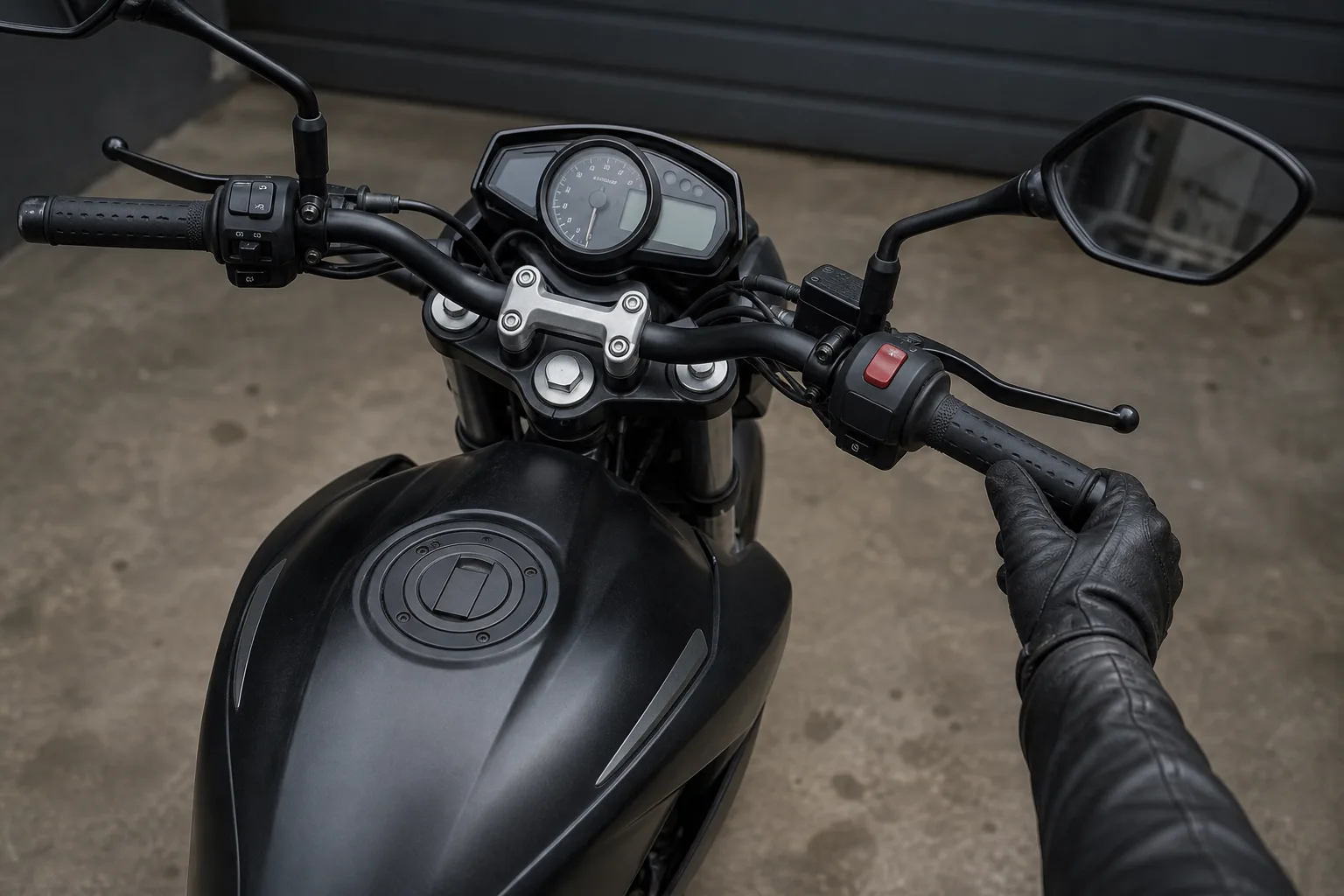
A throttle that behaves differently as the handlebars turn deserves immediate attention. MSF’s pre-ride checklist specifically calls for no revving when the handlebars are turned, and its controls review includes checking cable condition and routing for interference or pulling around the steering head. 1
That makes a full steering-range check a useful screening check, not a diagnosis. Keep the motorcycle stationary and follow the owner’s manual’s safety precautions. If turning the bars changes throttle feel or engine behavior, do not try to compensate by changing your riding plan, avoiding full-lock turns, or taking “just a short ride.”
Manufacturer documentation is the priority for your exact motorcycle. It accounts for the bike’s throttle design, routing, required free play where applicable, and any model-specific cautions. A Triumph technical notice, for example, warns that incorrect throttle-cable adjustment or routing can interfere with throttle function and directs owners to authorized service rather than improvised adjustment. That notice is model-contextual evidence—not a universal setting for every motorcycle. 3
Parked-Bike Throttle Safety Checklist
Use this as a stop-or-escalate checklist, not as a repair procedure.
- Park securely and follow the owner’s manual before checking controls.
- Confirm the throttle moves smoothly from closed to open and returns closed without help.
- Repeat the control check with the handlebars centered and then across their normal steering range.
- Stop immediately if return action changes, the grip binds, or engine speed changes with steering movement.
- Look only for plainly visible signs of cable damage, kinks, or routing interference; MSF identifies these as controls-inspection concerns. 1
- If there has been recent work near the handlebars, cables, or throttle assembly, do not assume the work is unrelated.
- Read the motorcycle’s owner’s manual before any adjustment or service decision.
- If normal operation is not unmistakably restored, arrange qualified service rather than riding to a shop.
For a broader routine that places this control check alongside tires, brakes, lights, fluids, chassis, and stands, see the Motorcycle Maintenance Guide.
If the Throttle Sticks While Riding

A sticking throttle while moving is an urgent control problem. Prioritize a stable path, traffic awareness, and getting out of the travel lane when safely possible.
MSF advises trying to rotate the throttle back and forth if the situation allows. If it remains stuck, MSF directs the rider to operate the engine cut-off switch and squeeze the clutch lever at the same time, then move to a safe area and stop. The engine sound may not drop immediately, but this removes power from the rear wheel. 2
Only use controls you already know on your motorcycle. Control locations and operation can differ between models, so becoming familiar with the engine cut-off switch before riding is part of the preparation—not something to discover in an emergency. 2
Once stopped, do not ride away merely because the symptom disappears. MSF says to ensure the throttle works freely before riding again; a conservative real-world decision is to arrange transport or qualified inspection when the cause is not plainly resolved through the manufacturer’s documented process. 2
What Not to Do
- Do not test a questionable throttle in traffic, on a public road, or during a “quick loop.”
- Do not guess at cable adjustment, routing, or free-play specifications from another model.
- Do not treat an intermittent symptom as harmless because it cannot be reproduced immediately.
- Do not add lubricant, loosen parts, or remove components without the model-specific manual’s direction.
- Do not ride to a service appointment if the throttle failed the parked check; choose pickup, towing, or another transport plan.
Preserve the Conditions That Reveal the Problem
An intermittent throttle concern can disappear when the motorcycle is parked straight ahead, bodywork is removed, or cables are moved. Record the handlebar position, engine state, temperature, recent service, accessory installation, crash or tip-over history, and whether the behavior changed after washing or transport. Do not keep manipulating a damaged system simply to produce a better video.
| Observation | Detail to record | Why it helps service |
|---|---|---|
| Grip does not return consistently | Handlebar position and whether the engine was off | Separates a general fault from steering-position sensitivity |
| Idle changes with steering movement | Direction and approximate point where it changes | Highlights routing, adjustment, or interference questions |
| Recent work occurred | Controls, bars, cables, tank, bodywork, accessories | Identifies areas that must be reverified |
| Damage or contamination is visible | Location and clear parked photographs | Preserves evidence without operating the motorcycle |
Verify the Repair Before Returning to Traffic
Ask the workshop to document the confirmed cause, parts and adjustments, routing checks, steering-lock verification, and any required lubrication or replacement. A statement that the throttle “feels better” is weaker than confirmation against the model procedure.
After service, inspect the parked motorcycle using the owner’s manual and confirm normal operation through the full steering range with the engine state specified by the procedure. Restore all covers and verify nothing interferes with the controls. Perform only a cautious low-speed functional check in a safe area after the motorcycle is declared roadworthy.
If the symptom returns, stop riding and preserve the new context. Do not compensate with hand force, altered riding technique, extra spring tension, or an improvised cable adjustment. Recurrence means the system requires another model-specific inspection.
Keep any removed or replaced component information with the service record. If an accessory or routing change contributed to the fault, document the corrected configuration so later handlebar, tank, or bodywork service does not recreate it.
Add the throttle check to every pre-ride routine after the repair. A short, consistent parked check is more useful than waiting for an on-road symptom to reveal that interference or adjustment has returned.
How Vojo Helps
Create a Controls Safety task in the Vojo motorcycle maintenance tracker after any work near the bars, throttle, or cables. Before the next ride, record a simple pass/fail note for free return with the steering centered and turned. If the result is anything but a clear pass, mark the bike unavailable, attach the service booking or technician findings, and keep the repair outcome in the same maintenance history instead of relying on memory.
Download Vojo on the App Store
Bottom Line
A throttle that does not snap back is not a tuning preference or an acceptable ride-home risk. Park the motorcycle, use the manufacturer’s documentation for the exact machine, and involve a qualified technician when operation, routing, or adjustment is uncertain. The correct outcome is predictable throttle control before the next ride—not a temporary workaround.
Sources
1 Motorcycle Safety Foundation, T-CLOCS Pre-Ride Inspection Checklist.
2 Motorcycle Safety Foundation, Motorcycle Operator Manual.
3 Triumph Motorcycles, Technical News TN_139_EN, hosted by NHTSA.
Quick answers
Frequently asked questions
Can I ride if the motorcycle throttle returns, but only slowly?
No. A throttle that returns slowly is not a clear pass on the free-return check. Do not ride; use the owner’s manual and arrange qualified inspection.
Why should I check the throttle with the handlebars turned?
MSF’s T-CLOCS checklist says the throttle should not cause revving when the handlebars are turned. A change during steering movement is a no-ride result that needs model-specific diagnosis.
What should I do if the throttle sticks while I am moving?
If conditions allow, MSF says to twist the throttle back and forth. If it remains stuck, operate the engine cut-off switch and squeeze the clutch lever at the same time, then move to a safe area and stop. Do not resume riding until free operation is confirmed.
Should I adjust throttle cables myself?
Follow only the exact owner’s manual or service-manual instructions for your motorcycle. If the adjustment, routing, or condition is uncertain, use a qualified technician; manufacturer documentation warns that incorrect adjustment can interfere with throttle operation.
Does this guidance apply to every motorcycle?
The stop-riding principle applies broadly, but the inspection details, control layout, throttle design, and service requirements are model-specific. Your motorcycle’s owner’s manual is the primary source.