
Motorcycle Side Stand Safety Check: Springs, Lean, Interlock, and No-Ride Warnings
Use this motorcycle side stand safety check to spot cracks, bends, weak spring retention, unstable parking lean, and interlock concerns before riding.

Fact-checked against cited official documentation
Reviewed against Fact-checked against MSF’s T-CLOCS stand inspection items and MSF guidance to follow the owner’s manual and make pre-ride checks routine..
Last updated September 30, 2026
A motorcycle side stand safety check is a small pre-ride habit with an outsized purpose: it helps you find a parking-support problem before the motorcycle falls while parked—or before a stand that should be stowed becomes a riding hazard.
The side stand is easy to overlook because it is usually only loaded while the bike is stopped. But it is part of the motorcycle’s chassis support, it lives low to the ground where it can strike curbs and uneven surfaces, and it may be connected to model-specific safety cut-out equipment. The Motorcycle Safety Foundation’s T-CLOCS inspection list specifically includes checking the side stand for cracks and bends, confirming its springs are present and retain it properly, and noting safety cut-out equipment where fitted. (msf-usa.org)
This guide is deliberately conservative. It is not an adjustment or repair guide, and it does not assume every motorcycle uses the same stand geometry or interlock logic. Your owner’s manual is the controlling source for your exact motorcycle—especially for side-stand operation, warning indicators, starting conditions, and any gear-related safety system. MSF likewise advises riders to study the owner’s manual and make pre-ride checks a habit. (msf-usa.org)
A useful way to think about the check is simple: Can the stand support the parked bike predictably, can it stay in its intended position, and does the motorcycle behave as its manual says it should? If the answer is uncertain, do not turn uncertainty into a ride.
Why a side stand deserves a separate check
A normal walk-around often covers tires, leaks, lights, and controls. The side stand can disappear into that larger routine because it is not a wear item riders touch continuously like a brake lever or throttle. Yet it affects two moments when a motorcycle is particularly vulnerable:
- When you leave the motorcycle parked. A stand that is bent, cracked, incompletely deployed, poorly retained, or sinking into the surface can leave the bike with less support than expected.
- When you begin riding. A stand that does not retract and remain stowed as intended, or a safety interlock that does not behave according to the owner’s manual, calls for a stop-and-confirm decision before traffic is involved.
The point is not to diagnose every possible cause from the driveway. A rider generally cannot confirm internal wear, switch condition, mounting alignment, or spring force by appearance alone. The point is to notice changes: a different lean, a new scrape, a stand that seems reluctant to stay up or down, a fresh impact mark, or behavior that differs from the manual.
That change-based approach is more reliable than memorizing what another person’s motorcycle looks like. Cruisers, standards, touring motorcycles, sport motorcycles, scooters, dual-sports, and adventure bikes may all rest at different angles and place their stands differently. Added luggage, a passenger setup, suspension changes, tire changes, or a different parking surface can also change what “normal” looks and feels like. Do not use a friend’s bike, a social-media clip, or a generic rule of thumb as the benchmark for yours.
Start with the owner’s manual, not assumptions

Manufacturer-first guidance matters here because the side stand is not just a metal leg. On some motorcycles, it may work with a warning or engine-management safety system. The exact conditions under which the motorcycle may start, idle, select a gear, or continue running can vary by model and market.
Before relying on an interlock, find the relevant pages in your exact owner’s manual. Look for sections commonly labeled side stand, starting the engine, safe riding, instruments and controls, or safety cut-off system. Record what the manual says rather than relying on memory. In particular, identify:
- whether the motorcycle has side-stand-related safety equipment;
- what the manual identifies as normal stand-up and stand-down behavior;
- any dashboard message, warning lamp, or displayed condition relevant to the stand;
- the manual’s cautions about starting, selecting gear, or riding with the stand deployed; and
- the manufacturer’s recommended response if the system does not operate normally.
Do not create your own functional test sequence from a generic article. The safe sequence, if the manufacturer specifies one, belongs in the owner’s manual for that model. If the manual is missing, obtain the correct official version using the motorcycle’s model identification information before treating any interlock behavior as normal.
A safety system also should not be used to excuse a poor physical inspection. Even if an interlock appears to respond normally, it does not make a cracked, bent, loose-looking, or poorly retained stand acceptable. Conversely, a stand can look ordinary while the motorcycle’s behavior differs from its manual. Treat the physical support check and the model-specific system check as two separate layers.
The four things to assess before you park or ride
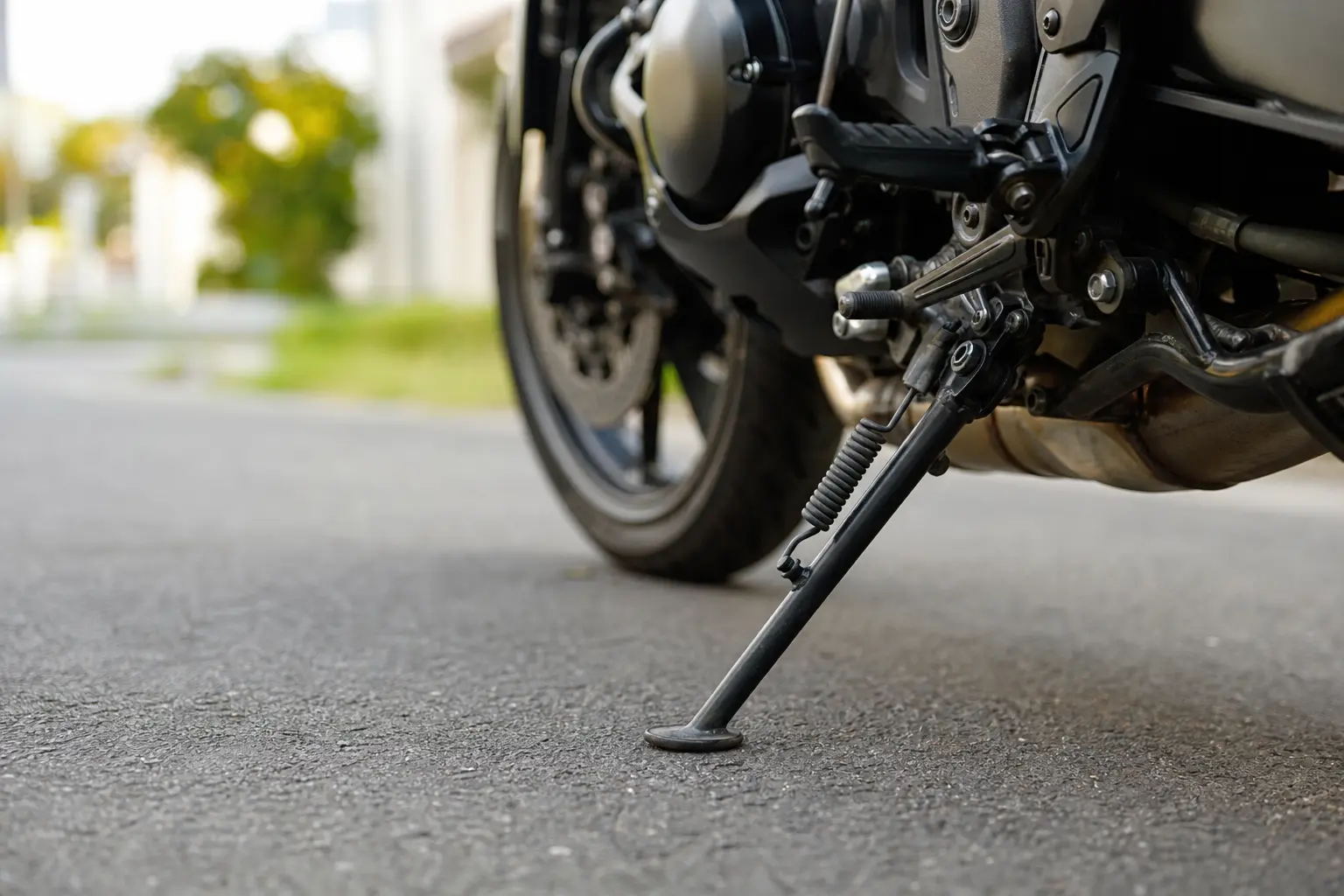
The table below turns a vague “check the kickstand” reminder into observable categories. It is intended for a parked-bike assessment, not a repair plan.
| Check area | What a rider can observe | Why it matters | Conservative response |
|---|---|---|---|
| Stand structure | Cracks, bends, fresh impact marks, unusual distortion, or damage around the visible stand area | Damage can change how the motorcycle is supported or how the stand moves | Do not rely on the stand if damage is visible; use a safer support option and arrange qualified assessment |
| Retention | Whether the stand appears to remain in its intended down or stowed position; whether the spring is present | MSF includes spring presence and retention in its stand check | Treat missing, displaced, or suspect spring retention as a no-ride concern until inspected |
| Parking lean and contact | Whether the bike settles into its familiar lean on firm, reasonably level ground; whether the foot has solid contact | Stable contact and familiar lean help reduce an avoidable parked-bike fall | Reposition on a better surface; if the lean has changed without a clear surface reason, pause and investigate |
| Safety cut-out equipment | Whether the motorcycle behaves as the exact manual describes for its stand-related system | Interlock behavior is model-specific and should not be guessed | Stop riding if operation differs from the manual; consult the manufacturer guidance or qualified service |
MSF’s checklist specifically calls out cracks, bends, springs, retention, and safety cut-out equipment under “Stands.” (msf-usa.org) The practical lesson is not that every issue can be resolved in a parking lot. It is that these are visible or behavior-based warning categories worth catching before you trust the stand or leave on the bike.
A clearly titled checklist: Motorcycle Side Stand Safety Check
Use this checklist before a ride, after a tip-over, after the stand contacts an obstacle, when parking conditions are questionable, or whenever the bike seems to lean differently than usual. Start with the motorcycle stationary and under your control. Keep the assessment calm and observational.
1. Choose a safe place to look
Park on firm ground where you can see the stand and the contact area. Avoid trying to judge a side stand while rushed, balancing on loose gravel, straddling the bike in traffic, or standing downhill from a motorcycle that could move. If the surface is soft, rutted, slippery, badly crowned, or steep, treat the surface itself as a separate risk. A sound stand cannot guarantee stability on poor ground.
2. Look for obvious structural damage
Inspect the visible stand for anything that is plainly not normal for your motorcycle: a crack, a bent shape, a flattened or damaged foot area, a fresh scrape consistent with an impact, or an abnormal relationship between the stand and its mounting area. Compare it with your memory, photos, or a prior inspection note rather than guessing what is acceptable.
Do not try to straighten, reshape, weld, shim, or otherwise improvise a correction at the roadside. Those actions can hide damage, alter support geometry, or introduce another failure point. If the stand is visibly damaged, the safe decision is to avoid relying on it and have the motorcycle evaluated according to manufacturer guidance.
3. Confirm the spring is present and retention seems normal
The MSF checklist identifies both spring presence and tension to hold position as stand-inspection points. (msf-usa.org) For a rider’s no-tools check, focus on what you can observe: Is the spring visibly there? Does the stand seem to remain in the expected position rather than appearing loose, floppy, or reluctant to stay where it belongs?
Do not attempt to judge a spring by comparing it to an arbitrary amount of force or by using another model as a reference. The meaningful standard is normal retention for your motorcycle. A missing spring, a spring that appears out of place, or a stand that will not stay predictably up or down is enough to stop and seek proper inspection.
4. Check the parked lean, but only on suitable ground
With the stand down on firm, reasonably level pavement or another stable surface, step back and assess whether the motorcycle rests with its familiar, settled lean. You are not looking for a universal angle. There is no single correct appearance across all motorcycle types.
Instead, ask practical comparison questions:
- Does the motorcycle look noticeably more upright or more leaned over than it normally does on similar ground?
- Is the side-stand foot fully supported rather than perched on an edge, resting on debris, or pressing into soft material?
- Does the bike seem settled, or does it feel as if a small change could make it roll or tip?
- Has a new accessory, load, tire, suspension setting, or parking surface changed the situation?
If you cannot answer confidently, reposition the motorcycle rather than testing your luck. It is generally easier to move a motorcycle before it falls than to recover it after it has fallen.
5. Consider slope, surface, and departure direction
A side stand that appears normal on level pavement can be a poor choice on a slope, slick paint, loose stone, hot asphalt, mud, grass, or a surface with a hidden void below the foot. Before you walk away, consider whether the motorcycle could roll, whether the foot may sink, and whether the planned departure requires awkward backing or a difficult uphill push.
This is not a reason to avoid all imperfect parking. It is a reason to make the parking decision consciously. Choose the most stable available spot, verify the contact area, and leave enough room to retrieve the bike without forcing it into a precarious maneuver. For broader parking judgment, see our guide to parking a motorcycle on a slope or soft surface.
6. Check model-specific safety-system behavior against the manual
If your motorcycle has side-stand safety cut-out equipment, compare its behavior only with the instructions for your exact model. A new warning indication, an unexpected engine response, a change in gear-related behavior, or any operation that conflicts with the manual is not a puzzle to solve by bypassing a component or trying repeated experiments.
Stop, secure the motorcycle, and consult the manual’s troubleshooting or service direction. If it is not clear that the motorcycle is functioning as specified, arrange qualified evaluation. Never bypass or defeat a safety-related device to continue a ride.
7. Make a go/no-go decision before moving
The final question is not “Can I probably make it home?” It is “Do I have enough information to trust the motorcycle’s support and stand-related safety behavior today?” If the answer is no, do not ride. Use a safer transportation or recovery plan, then resolve the issue through the manufacturer’s recommended route or qualified service.
What normal parking stability looks like—and what it does not prove
A side stand is only one part of a stable parking setup. The motorcycle also depends on surface firmness, ground angle, tire contact, steering position, load placement, wind exposure, and whether another vehicle or person could bump it. This is why a quick lean-angle glance is useful but incomplete.
A stable parked motorcycle typically has a stand foot supported by solid ground, a settled and familiar lean for that motorcycle, and no obvious sense that it is balancing at the edge of its support. But this observation does not prove the stand is structurally sound, the spring is healthy, or the interlock is working. It is a screening step, not a certification.
Likewise, a changed lean does not automatically prove the stand is damaged. The explanation might be the pavement crown, a loaded luggage case, soft ground, tire pressure concerns, suspension changes, or a shifted parking position. The correct response is still conservative: first move to a known, firm, level reference spot if practical; then re-evaluate. If the change remains, do not assume it will correct itself on the road.
A helpful rider habit is to notice the motorcycle each time you step away from it. This is not obsessive. It is pattern recognition. You learn the usual visual posture of your motorcycle so an unusual posture is easier to spot early.
No-ride warnings: when to stop rather than troubleshoot
The following conditions deserve a conservative no-ride decision until the motorcycle can be assessed properly:
- A visible crack, bend, fracture-like mark, or fresh impact damage on the side stand or its visible support area.
- A missing spring or a spring that appears displaced, damaged, or unable to retain the stand predictably.
- A stand that will not remain reliably stowed or deployed as expected.
- A motorcycle that suddenly rests at an unfamiliar lean on firm, level ground without a clear and harmless explanation.
- A side-stand foot that cannot get secure support because the surface is soft, unstable, slick, or shaped poorly for parking.
- Any stand-related warning, starting condition, gear-related behavior, or engine behavior that differs from the owner’s manual.
- Damage or abnormal behavior after a fall, curb strike, transport incident, or contact with trail debris.
These are not diagnoses. They are decision triggers. A rider does not need to identify the failed part to recognize that the motorcycle should not be trusted for normal use.
If a concern arises during a ride, do not continue merely to get to a more convenient destination. Choose the safest reachable stopping location, avoid repeated attempts to “see if it goes away,” and reassess from a stable parked position. The same principle applies to any safety-critical pre-ride item: ambiguity is a reason to reduce exposure, not a reason to collect more risk.
Avoid these common mistakes
Mistake: treating the interlock as a substitute for inspection
A safety cut-out system is not a visual crack detector, a parking-surface detector, or a guarantee that the stand is secure. Perform the physical check as well as the manual-based system check.
Mistake: assuming all side stands should look the same
Different designs park at different lean angles and use different mechanisms. Do not copy settings, appearance standards, or informal tests from another motorcycle.
Mistake: parking first and inspecting later
If the ground is poor, assess it before committing the motorcycle’s weight to the stand. If it looks questionable, choose another spot or a more stable support strategy rather than hoping the foot will hold.
Mistake: overlooking a small impact
A light curb touch or drop may not leave dramatic damage, but it is a reasonable reason to slow down and inspect. Changes in shape, retention, motion, or lean matter more than whether the event felt serious at the time.
Mistake: improvising a roadside repair
Avoid bending, tying, wedging, defeating, or bypassing parts to make the motorcycle usable. A temporary-looking solution can change how the bike supports itself or interfere with a safety system. Secure the motorcycle and seek appropriate help instead.
Mistake: relying on one rushed pre-ride habit forever
A fast routine is valuable, but it should expand after anything changes: a fall, a long storage period, a service visit, a new load setup, a new noise, or unfamiliar parking conditions. The broader Motorcycle Maintenance Guide can help you turn those changes into a repeatable inspection and service routine.
Build the check into your wider pre-ride routine
The best side-stand check is usually brief because it is repeated. It belongs inside a larger pre-ride habit that looks at tires and wheels, controls, lights and electrics, fluids, chassis items, and stands. That is the logic behind MSF’s T-CLOCS structure, which includes a specific “Stands” category rather than treating parking support as an afterthought. (msf-usa.org)
You do not need to perform a long technical inspection every time you stop for fuel. Instead, use layers:
- Every ride: Scan the stand, spring presence, parking contact, and anything visibly changed.
- After an event: Add a closer look after a tip-over, obstacle strike, transport, extended storage, or unfamiliar warning.
- Before a long trip or loaded ride: Review the owner’s manual, check parking strategy, and make sure the extra load has not changed your normal observations.
- When uncertain: Stop escalating your own testing and get qualified assistance.
This layered approach supports safer decisions without pretending that a rider can replace model-specific information or professional evaluation. MSF’s general safety guidance emphasizes knowing the motorcycle, studying the owner’s manual, and making a pre-ride check habitual. (msf-usa.org)
How Vojo Helps
Create a recurring pre-ride inspection in the Vojo motorcycle maintenance tracker with a dedicated “Side stand” item. After each check, log one of three simple outcomes—normal, monitor, or do not ride—and add a photo or note when you see an impact mark, altered lean, questionable spring retention, or behavior that needs manual-based follow-up. Before a trip, review the previous entries alongside your service history so a small repeated observation does not get lost between rides.
Quick answers
Frequently asked questions
How often should I do a motorcycle side stand safety check?
Make a quick visual and stability check part of every pre-ride routine. Add a closer assessment after a drop, curb or trail contact, transport, long storage, an unfamiliar lean angle, or any side-stand-related warning or unusual behavior.
My motorcycle leans more than usual on the side stand. Is it safe to ride?
Do not assume it is safe or unsafe from lean alone. First rule out an unsuitable surface or unusual load by moving to firm, reasonably level ground if you can do so safely. If the change remains or you see damage, do not ride until the motorcycle is assessed according to manufacturer guidance.
Can I ride if the side stand spring is missing or looks out of place?
No. MSF includes spring presence and retention in its stand inspection. A missing, displaced, or suspect spring means the stand may not stay in its intended position. Secure the motorcycle and arrange proper inspection rather than improvising a fix.
How do I test a motorcycle side-stand safety switch?
Use only the exact method and normal-operation description in your owner’s manual. Interlock logic varies by model. If the motorcycle behaves differently than the manual states, do not bypass the system or create a generic test; stop riding and seek qualified help.
Is a side stand safe on gravel, grass, hot asphalt, or a slope?
Those surfaces can reduce stability even when the stand itself is sound. Check that the foot has firm support, consider whether it may sink or slip, assess the motorcycle’s lean and potential to roll, and choose a more stable location when doubt remains.
What should I do after my motorcycle falls onto the side stand?
Do not assume the stand escaped damage because the motorcycle still appears to park. Inspect for visible cracks, bends, fresh impact evidence, spring-retention concerns, changed lean, and any behavior that conflicts with the owner’s manual. If anything is uncertain, do not ride until it is evaluated.