
Motorcycle Luggage Loading: A Weight, Balance, Clearance, and Securement Checklist Before a Trip
Use this motorcycle luggage loading checklist to total the load, follow model limits, pack low and balanced, confirm clearance, and test the bike before departure.
Fact-checked against cited official documentation
Reviewed against MSF travel guidance on packing and fully loaded test rides, plus Honda owner-manual loading guidance covering model-specific limits, securement, balance, center placement, and clearance from lights and the muffler..
Last updated September 23, 2026
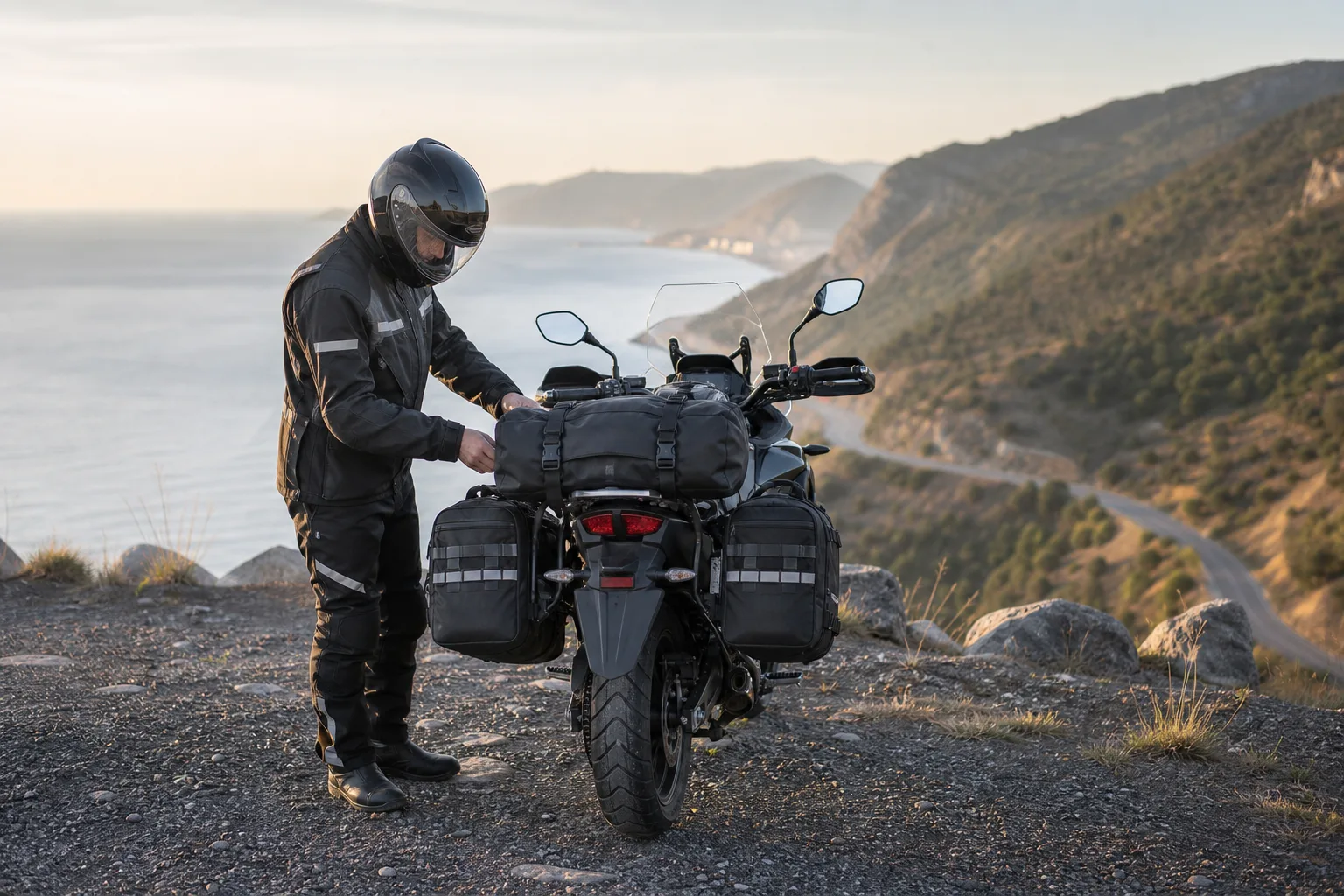
Motorcycle luggage loading checklist decisions should start before anything goes into a pannier, tail bag, or duffel: confirm what the motorcycle and its installed luggage are approved to carry. Then pack for balance, clearance, and control—not simply for maximum volume.
Extra mass can affect handling, braking, and stability. Honda’s owner-manual guidance also illustrates why there is no universal cargo number: the applicable weight capacity is model-specific and may account for the rider, passenger, luggage, and accessories together. Start with your own motorcycle’s owner’s manual and the instructions for every fitted luggage component. Honda’s NM4 owner’s manual is a useful example of this model-first approach.
Build the load calculation before packing
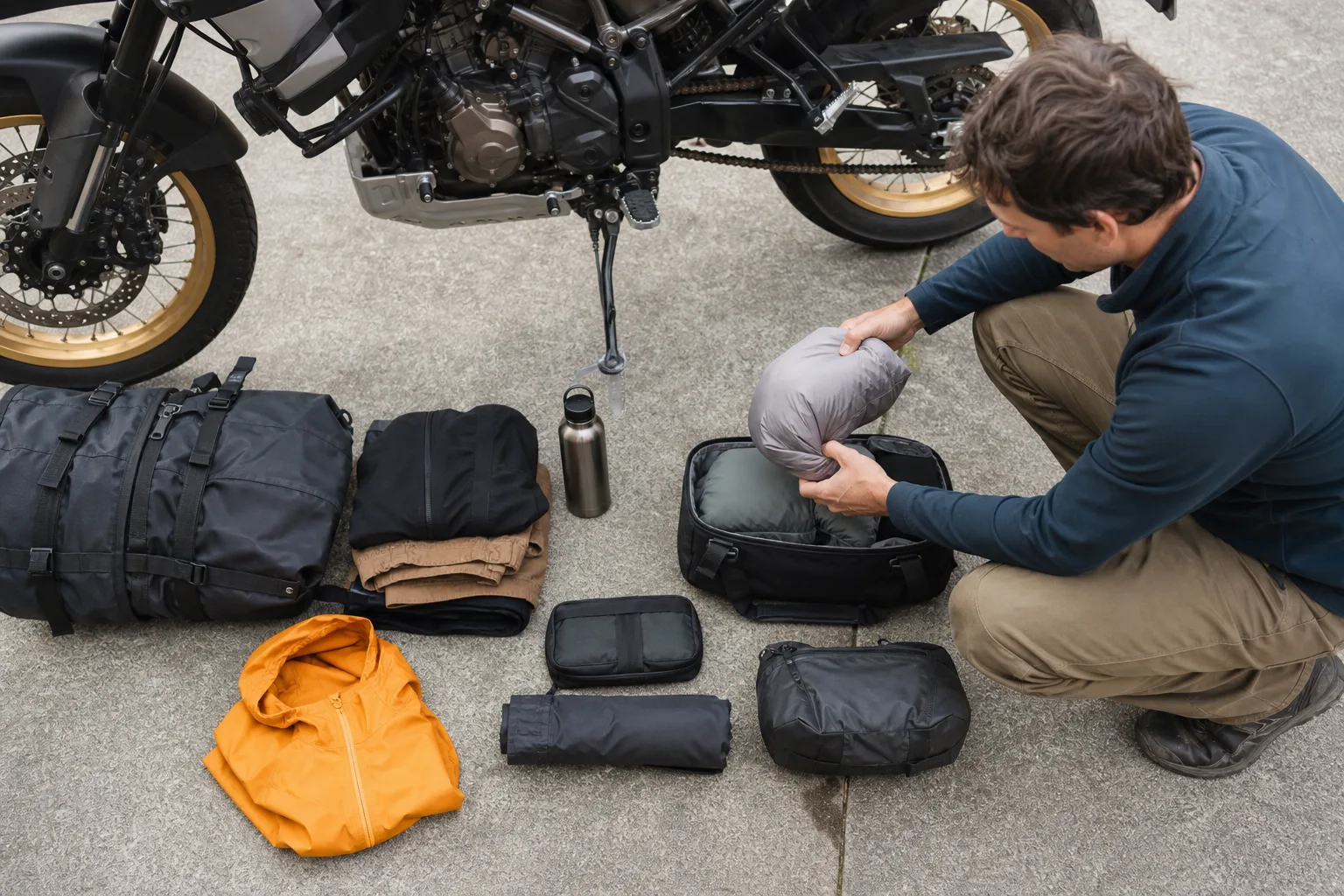
Use the limits stated for your motorcycle—not a forum estimate, a rack’s appearance, or another model’s specification. Check both the motorcycle’s overall capacity and any separate limits for a rack, top case, pannier, utility compartment, or accessory system.
| Checkpoint | What to confirm | Conservative decision if unclear |
|---|---|---|
| Overall capacity | How your manual defines the maximum permitted load and which people/items it includes | Reduce the trip load and verify the manual before riding |
| Luggage-system limits | Whether fitted cases, racks, mounts, or compartments have their own load limits | Treat the component as unsuitable until its instructions are confirmed |
| Load inventory | Rider gear, passenger gear, cargo, luggage, and added accessories that apply under your manual | Weigh or simplify the setup rather than guessing |
| Placement | Dense items sit low, close to the motorcycle’s center, and are divided side-to-side | Move weight inward and lower, then reassess |
| Ride readiness | The loaded motorcycle remains comfortable and controllable for the rider | Remove cargo or delay departure until it does |
Do not treat a case’s empty volume as permission to fill it. A small amount of dense cargo can matter more than a large but light layer of clothing. Motorcycle Safety Foundation travel guidance recommends putting heavier items lower in the luggage and riding the motorcycle fully packed before a longer trip to make sure it remains comfortable to control. MSF’s travel-by-motorcycle guidance supports that practical test.
Pack for balance, not just convenience
Place the heaviest practical items in the lowest available approved location, near the motorcycle’s centerline. Split comparable weight between left and right luggage where the system allows. Keep frequently used but light items—such as a rain layer, documents, or snacks—in easy-access locations.
Avoid creating a high, rearward stack simply because it is quick to load. A tall tail load can be inconvenient to mount around, can make the bike feel different at low speed, and may make a small packing error harder to notice. If one side bag carries a dense tool roll or other heavy item, look for a sensible way to offset that mass rather than leaving the motorcycle noticeably one-sided.
A passenger changes the calculation. Passenger weight, their protective gear, and their belongings all belong in the total-load review when the manual defines capacity that way. Do not solve an overloaded setup by asking a passenger to wear a heavy backpack.
Clearance, securement, and ride-ready checks
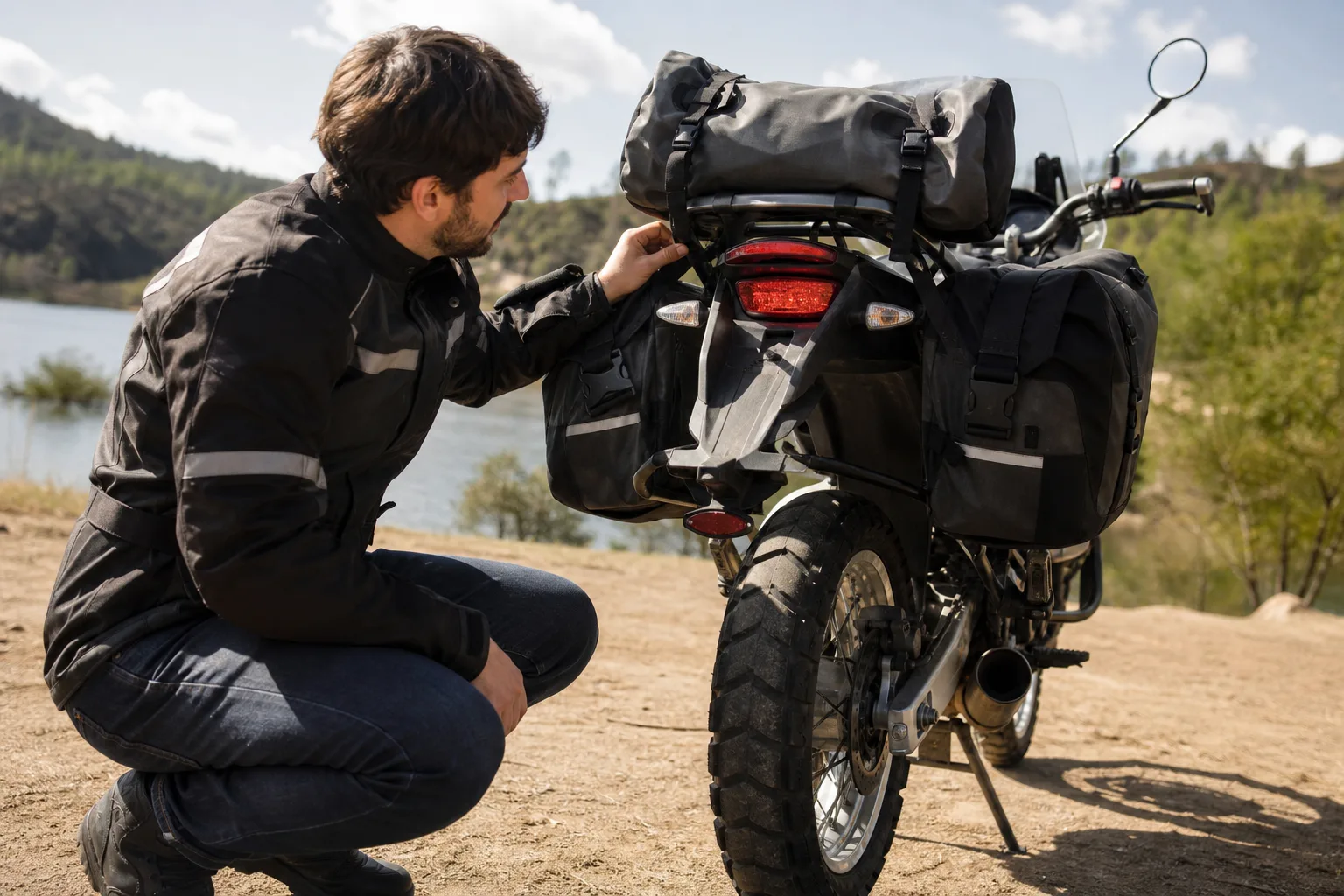
Cargo must stay put and stay out of the motorcycle’s operating space. Honda’s loading guidance says to secure luggage, keep it evenly balanced and close to the center of the motorcycle, and avoid placing objects near lights or the muffler. It also warns that overload or improper loading can lead to a crash. Honda’s NM4 owner’s manual
Before leaving, look for obvious contact risks around hot exhaust parts, lighting, controls, the wheel area, suspension travel, chain or belt area where applicable, and passenger footpeg space. Follow the motorcycle and luggage manufacturers’ instructions for mounting and load limits; do not improvise attachment points or modify the luggage system for a trip.
Motorcycle luggage loading checklist
- Read the current owner’s manual for overall load capacity and loading instructions.
- Check instructions and limits for every installed rack, case, bag, mount, or compartment.
- Include the rider, passenger where applicable, protective gear, luggage, cargo, and relevant accessories in the load review.
- Remove nonessential heavy items before trying to rearrange an excessive load.
- Put heavier practical items low and close to the motorcycle’s center.
- Divide comparable weight between the left and right sides.
- Confirm luggage is closed, mounted as instructed, and unable to shift under normal hand pressure.
- Confirm cargo does not obstruct lights, interfere with controls or passenger space, or sit near hot or moving parts.
- Review the owner’s manual for the tire-pressure and suspension guidance that applies to your planned load.
- Complete the normal pre-ride inspection, then take a short, controlled fully loaded test ride before the trip.
- Recheck the luggage after the test ride and at fuel or rest stops.
For the broader condition check around a trip, use the Motorcycle Maintenance Guide.
Reassess tires, suspension, and riding margins
Cargo is not separate from the rest of the motorcycle. Before departure, inspect tires and use the pressure guidance specified by your owner’s manual for the planned load. Check the manual for any load-related suspension instructions as well. If the motorcycle feels unsettled, bottoms out, has reduced clearance, or cannot be controlled confidently when packed, do not continue by simply riding faster or tightening straps harder: reduce the load and resolve the setup first.
A loaded motorcycle also deserves more riding margin. Leave earlier, allow extra following distance, and make the first portion of the route a check-in period rather than a high-speed push. A short shakedown ride is useful because it tests the whole system: the packing list, mounting choices, rider reach, passenger space, and how the motorcycle responds when ready for travel.
Recheck the Load During the Trip
A load that was secure in the garage can change after vibration, rain, heat, opening a bag, or removing one item. Build inspection stops into the trip and repeat the securement, clearance, light visibility, and tire observations specified by the motorcycle and luggage manufacturers. Stop immediately if the load shifts or contacts a wheel, chain, belt, exhaust, suspension, steering, brake, or light.
When removing or adding gear, recalculate the arrangement rather than leaving one side light or moving dense items higher for convenience. Keep emergency and frequently used items accessible without weakening the main securement. Never unpack where traffic or unstable ground creates a new hazard.
After the trip, record what moved, became wet, was difficult to reach, or changed the motorcycle more than expected. Inspect mounting points and luggage for wear or damage before the next ride. A repeatable packing list should include each item’s location and approximate mass, not only its name.
How Vojo Helps
Create a trip-prep entry in the Motorcycle Maintenance Tracker before packing. Add a task for the owner-manual load review, record the tire and suspension checks required for your model, list the luggage setup, and mark a follow-up check after the shakedown ride. This gives you a repeatable record for future trips instead of relying on memory.
Download Vojo on the App Store
FAQ
Does cargo weight include the rider and passenger?
Use the definition in your motorcycle’s owner’s manual. Manufacturer documentation may define maximum capacity as including the rider, passenger, luggage, and accessories, so do not assume cargo has a separate allowance.
Should the heaviest items go in a top case?
Not by default. Start with the motorcycle and luggage manufacturers’ limits, then keep heavier practical items lower and closer to the motorcycle’s center. Reserve high or rearward spaces for lighter items when possible.
Can I use any bag if the straps seem strong enough?
No. Prefer luggage and mounting methods intended for the motorcycle and follow their instructions. A strong-looking strap does not establish that the bag, attachment points, clearances, or rack are suitable for the load.
How do I know if my luggage is packed too high or too far back?
There is no universal measurement. If the packed bike is hard to control comfortably, has obvious clearance concerns, or does not feel appropriate on a short controlled test ride, reduce and reposition the load.
When should I recheck luggage during a trip?
Check it after the initial shakedown ride and periodically during the trip, especially after rough roads, weather changes, or any stop where luggage was opened or moved.
Sources
Quick answers
Frequently asked questions
Does cargo weight include the rider and passenger?
Use the definition in your motorcycle’s owner’s manual. Manufacturer documentation may define maximum capacity as including the rider, passenger, luggage, and accessories, so do not assume cargo has a separate allowance.
Should the heaviest items go in a top case?
Not by default. Start with the motorcycle and luggage manufacturers’ limits, then keep heavier practical items lower and closer to the motorcycle’s center. Reserve high or rearward spaces for lighter items when possible.
Can I use any bag if the straps seem strong enough?
No. Prefer luggage and mounting methods intended for the motorcycle and follow their instructions. A strong-looking strap does not establish that the bag, attachment points, clearances, or rack are suitable for the load.
How do I know if my luggage is packed too high or too far back?
There is no universal measurement. If the packed bike is hard to control comfortably, has obvious clearance concerns, or does not feel appropriate on a short controlled test ride, reduce and reposition the load.
When should I recheck luggage during a trip?
Check it after the initial shakedown ride and periodically during the trip, especially after rough roads, weather changes, or any stop where luggage was opened or moved.