
Motorcycle Maintenance by Mileage: Build the Right Schedule
Learn how to turn your motorcycle's official mileage and time intervals into a practical service plan without relying on a universal schedule.
Fact-checked by Vojo Editorial Team
Reviewed against Honda owner manuals and manufacturer maintenance schedules.
Last updated September 23, 2026
“Service every 3,000 miles” is easy to remember and often wrong. A motorcycle maintenance schedule is a matrix of distance, elapsed time, inspection results, operating conditions, and model-specific procedures. Two motorcycles can require different work at the same odometer reading, and a motorcycle that covers little distance may still reach a time limit.
The goal is not to memorize a generic chart. It is to convert the official schedule for your exact motorcycle into a record you can follow.
The four inputs that control a schedule
| Input | Why it matters | Where to verify it |
|---|---|---|
| Mileage or kilometers | Many inspections and replacements repeat at distance intervals | Owner or service manual maintenance table |
| Elapsed time | Fluids, rubber parts, corrosion, and stored motorcycles can age without accumulating mileage | Time column and maintenance notes |
| Riding conditions | Dust, rain, mud, competition, short trips, heavy loads, and temperature extremes may change requirements | Severe-use notes in the manual |
| Component condition | Damage, leakage, wear, contamination, or abnormal operation can require action before the scheduled interval | Pre-ride checks, wear limits, and inspection procedure |
Treat the schedule as the baseline, not permission to ignore a developing problem until the next mileage marker.
Step 1: identify the exact documentation
Record the motorcycle's make, model, model year, market, and VIN where relevant. Manuals for similar model names can specify different capacities, fluids, torque values, and intervals. Use a manufacturer-hosted manual, the documentation supplied with the bike, or an authorized service source.
Manufacturer schedules also use symbols and footnotes. Read the key before copying rows. A mark may mean inspect, clean, adjust, lubricate, or replace; those actions are not interchangeable.
Step 2: capture the initial service separately
New motorcycles often have an early first service. Do not infer its mileage or tasks from another model. Copy the exact distance, time condition, and required operations from the manual and preserve service proof when warranty conditions matter.
Your record should include:
- due mileage and date;
- actual mileage and completion date;
- work performed and fluid or parts specification;
- technician or workshop when applicable;
- invoice, notes, and the next due point.
Step 3: turn repeating rows into reminders
Create one item for each actual schedule row rather than one vague “major service” reminder. Typical categories include engine oil and filter, air cleaner, valve clearance, spark plugs, cooling system, brake system, tires and wheels, steering, suspension, fasteners, and the motorcycle's chain, belt, or shaft drive.
Do not assign a universal interval to those categories. For example, oil requirements differ by engine and use; valve inspections may be separated by many thousands of miles; shaft-drive service is irrelevant to a chain-driven bike.
Step 4: apply time limits and the “first reached” rule
If the schedule says distance or time, plan for whichever occurs first. This matters for low-mileage and seasonal motorcycles. Use a real calendar due date rather than estimating it from average future mileage.
Before storage or returning to service, also follow the manufacturer's storage section. The pre-season checklist helps organize the inspection but does not replace that procedure.
Step 5: account for severe conditions
Read every schedule note. Off-road dust, repeated rain, mud, competition, high loads, very short trips, or other conditions can require cleaning, lubrication, inspection, or replacement more often. Only apply the condition that actually matches the motorcycle's use and documentation.
A service-plan checklist
- Confirm exact model, year, and official manual.
- Copy the initial-service requirement.
- Record current mileage and the date of the last known service.
- Enter each repeating task with its distance and time rule.
- Add manual footnotes and severe-use conditions.
- Mark unknown history as unknown—do not invent completion dates.
- Inspect the motorcycle for current problems before relying on the calendar.
- Save completion evidence and calculate the next due point.
Turn the manual table into a living plan
A maintenance table becomes easier to use when each row is a decision with a due point, required action, and completion record. Separate inspection from replacement: an instruction to inspect does not mean the part must always be replaced, and a replacement interval should not become “inspect when convenient.” Preserve the manufacturer’s verb so the next person understands what was required.
| Schedule field | What to record | Why it prevents mistakes |
|---|---|---|
| Exact motorcycle | Model, year, market, and VIN context where relevant | Prevents copying a schedule from a similar-looking model |
| Required action | Inspect, clean, adjust, lubricate, or replace | Keeps different maintenance verbs from becoming interchangeable |
| Trigger | Distance, elapsed time, or both | Makes the “first reached” rule visible |
| Completion evidence | Date, mileage, parts or fluid, notes, invoice | Shows what was actually done rather than merely planned |
| Next due point | Calculated mileage and date | Converts history into an actionable reminder |
For every item, record both the distance trigger and the time trigger when the manual provides them. Calculate the next due point from the rule the manufacturer gives, not from whichever number produces the later date. If work was completed early, note whether the next interval begins from that service or remains anchored to the original schedule.
Handle missed, unknown, and incomplete history
A used motorcycle may arrive with gaps, vague receipts, or a seller’s memory instead of a service record. Do not mark an item complete merely because the motorcycle runs well. Create an “unknown” state, identify which tasks affect immediate safety or reliability, and use the owner’s manual plus a qualified inspection to establish a trustworthy baseline.
When a service is overdue, avoid assuming that completing only the single late item resets the entire schedule. Other time- and distance-based rows may also be due. Review the schedule as a system. If work requires special tools, safety procedures, calibration, or model-specific measurements, book qualified service instead of turning a reminder into an improvised repair.
Review the schedule when use changes
Update the plan after a change in ownership, climate, storage, annual mileage, passenger or luggage use, or repeated operation in severe conditions. Accessories and modifications may introduce their own inspection requirements. Keep those requirements alongside the motorcycle schedule without presenting them as original manufacturer rows.
At least once per season, compare the saved plan with the documentation you rely on. Check that the model and market still match, no row was omitted, and completed work has supporting details. After a workshop visit, translate a generic invoice line such as “full service” into the specific items actually completed.
Before an appointment, summarize due items, current mileage, symptoms, previous related work, and the applicable documentation. Ask the workshop to distinguish completed, recommended, and deferred work. Attach the invoice and update each task separately so the next maintenance decision remains auditable.
Keep the schedule usable between services
Review upcoming work before long trips, storage, major load changes, or a workshop visit. Grouping tasks can be convenient, but do not silently move a safety-critical or warranty-related deadline merely to create one appointment. Mark intentionally early work as early and preserve the original basis for the next due calculation.
When the odometer, instrument cluster, engine, or ownership record changes, document the transition. A replacement display or uncertain mileage should not erase service history; record the known reading, the date of change, and the best supported cumulative context. Never invent a precise mileage when the evidence supports only an estimate.
Separate reminders from condition findings. A future due date does not override a leak, warning lamp, abnormal control feel, damage, or other present concern. Conversely, a normal pre-ride check does not cancel a scheduled replacement or inspection. The schedule and the current-condition inspection answer different questions and should remain linked without being confused.
Finally, archive superseded documents rather than deleting them. If the manufacturer publishes corrected information or the workshop provides model-specific service data, record which version informed the decision. A durable history should let a future owner or technician understand not only when work happened but why it was considered due.
How Vojo Helps
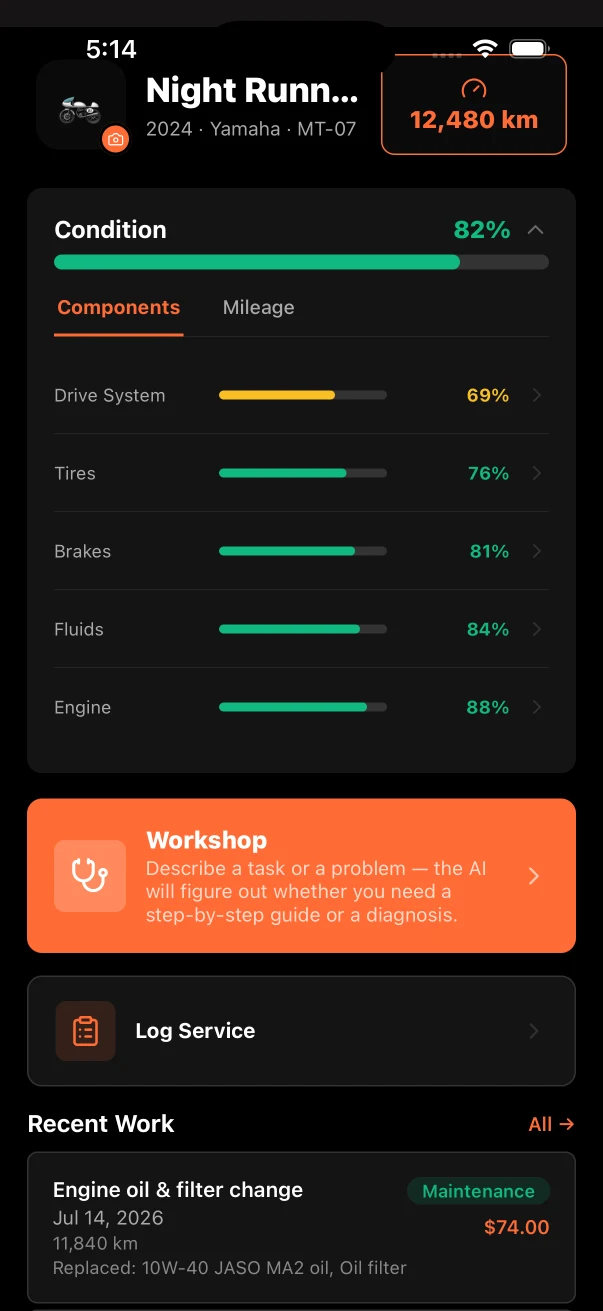
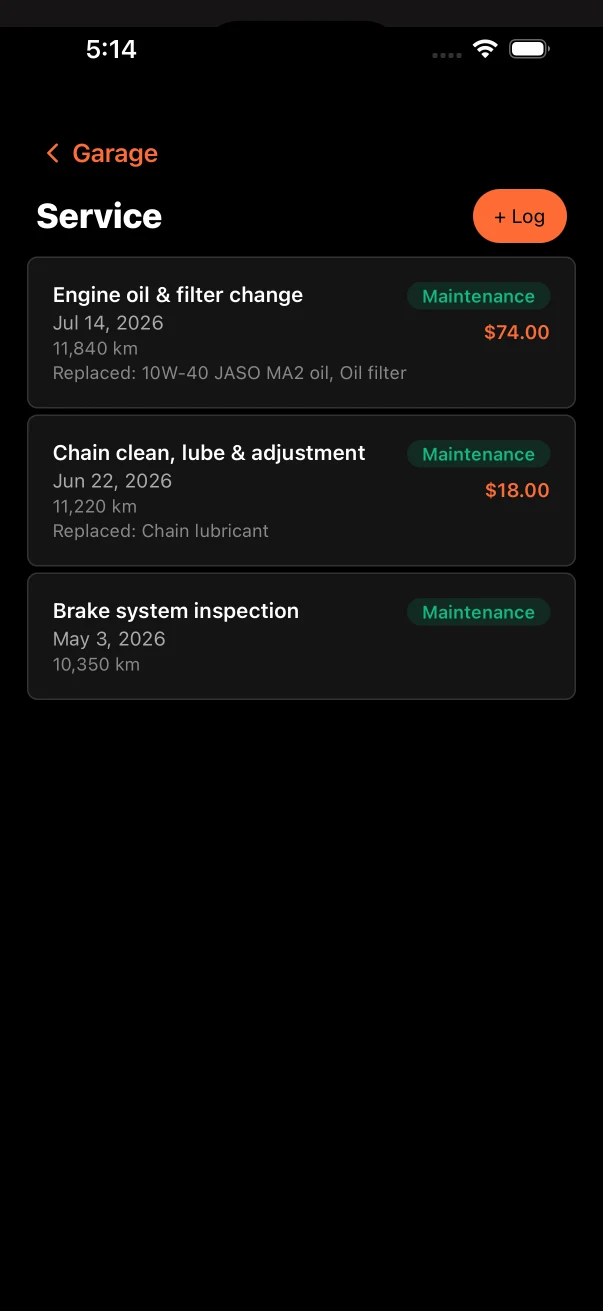
Vojo's motorcycle maintenance tracker keeps the bike, odometer, component records, completed services, and upcoming work together. Suggested intervals are a starting point only; verify them against the official schedule before saving or acting on them.
Download Vojo on the App Store
Official sources and further reading
- Honda CBR600RR Owner's Manual — an example of a model-specific maintenance schedule, oil requirements, and inspection instructions.
- Honda Powersports FAQs — directs owners to the maintenance section of their owner's manual.
This guide explains how to organize a schedule. It does not supply the service intervals for your motorcycle. Use the exact manual or a qualified mechanic for the final plan.
Inside Vojo
See the schedule and completed work in Vojo
Quick answers
Frequently asked questions
Is there one maintenance schedule for every motorcycle?
No. Intervals and procedures vary by model, year, market, engine, final drive, and riding conditions. Use the official schedule for the exact motorcycle.
Should I service by mileage or by time?
Follow whichever limit the manufacturer reaches first when the schedule gives both. Low annual mileage does not eliminate time-based fluid, inspection, or storage requirements.
Does severe use change service intervals?
Often yes. Dust, mud, water, competition, short trips, extreme temperatures, heavy loads, and other conditions may require additional or more frequent work when the manual says so.
Can Vojo calculate the official interval for my bike?
Vojo can organize mileage, dates, records, and suggested reminders. Verify every interval against the official documentation for the exact model.