
Be Seen Without Overtrusting Visibility Gear: A Motorcycle Intersection Safety Plan
Motorcycle intersection visibility safety tips that pair bright gear and lighting with scanning, lane position, time, space, and escape planning.
Fact-checked against cited official documentation
Reviewed against Fact-checked against NHTSA motorcycle and conspicuity guidance plus MSF guidance on visibility, lane position, time, space, signals, and escape paths..
Last updated September 23, 2026
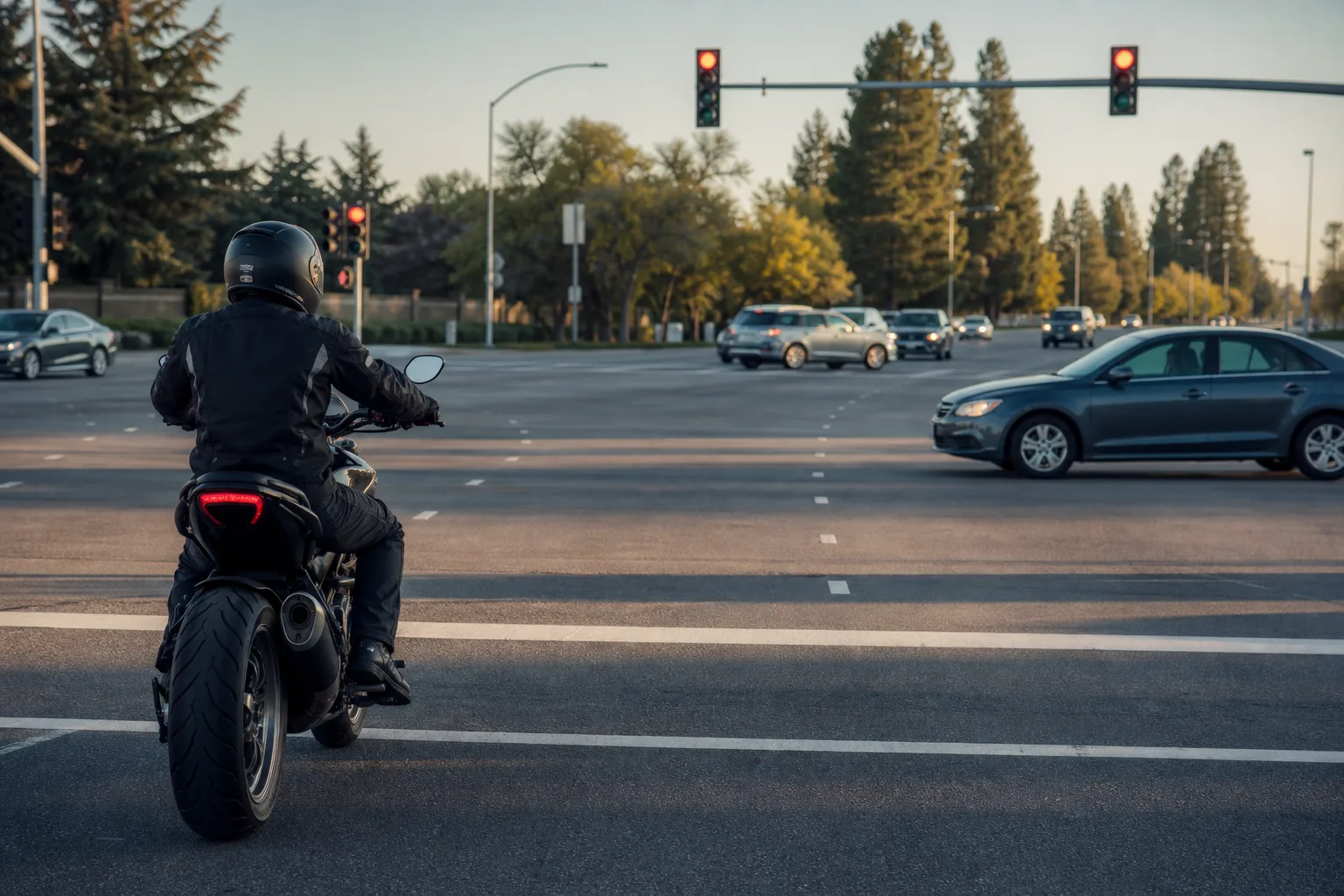
Motorcycle intersection visibility safety tips start with an uncomfortable truth: gear and lighting can improve your chances of being noticed, but they cannot make another road user look, understand your path, or yield.
Bright or light-colored gear, reflective material, and a working headlight are worthwhile layers. NHTSA and the Motorcycle Safety Foundation (MSF) both encourage those measures. But each belongs in a broader plan built around anticipation, position, time, space, and a usable way out. [1][2]3
Visibility Is an Advantage, Not a Right-of-Way Guarantee
Think of conspicuity as a way to improve the signal you present to traffic—not proof that traffic has received it. A driver may be distracted, looking through you toward a larger vehicle, judging your speed poorly, or simply committing to a turn before recognizing the motorcycle.
That distinction changes how to approach an intersection. Do not trade caution for confidence because you are wearing a high-visibility jacket or because your headlight is on. Instead, use those tools while riding as though a conflicting vehicle may still enter your path. MSF specifically advises riders to search for vehicles that could turn across their path, especially at intersections, and to maintain an escape route. 3
Start with manufacturer-first basics: follow your motorcycle owner’s manual for its intended lighting and control operation. Before riding, confirm that the headlight and turn signals operate normally. NHTSA also recommends checking lighting and signal indicators before every ride. If something is not working as intended, resolve it according to the manual or arrange qualified service before relying on the bike in traffic. 1
| Safety layer | What it contributes | What it cannot do | Rider response |
|---|---|---|---|
| Bright or reflective gear | Makes your outline more noticeable in daylight or low light | Force a driver to look or yield | Still anticipate a conflict |
| Headlight use | Adds contrast from the front | Prove that a driver has judged your speed or distance correctly | Reduce uncertainty at crossings |
| Lane position | Can improve your sight line and presence in a driver’s view | Eliminate blind spots or blocked views | Adjust as the traffic picture changes |
| Turn signals | Communicate your planned direction | Prevent another road user from cutting across you | Signal early, then verify the path |
| Time and space | Gives you more options if the situation changes | Remove every hazard | Arrive prepared to slow, stop, or move away |
Build Your Approach Before the Intersection
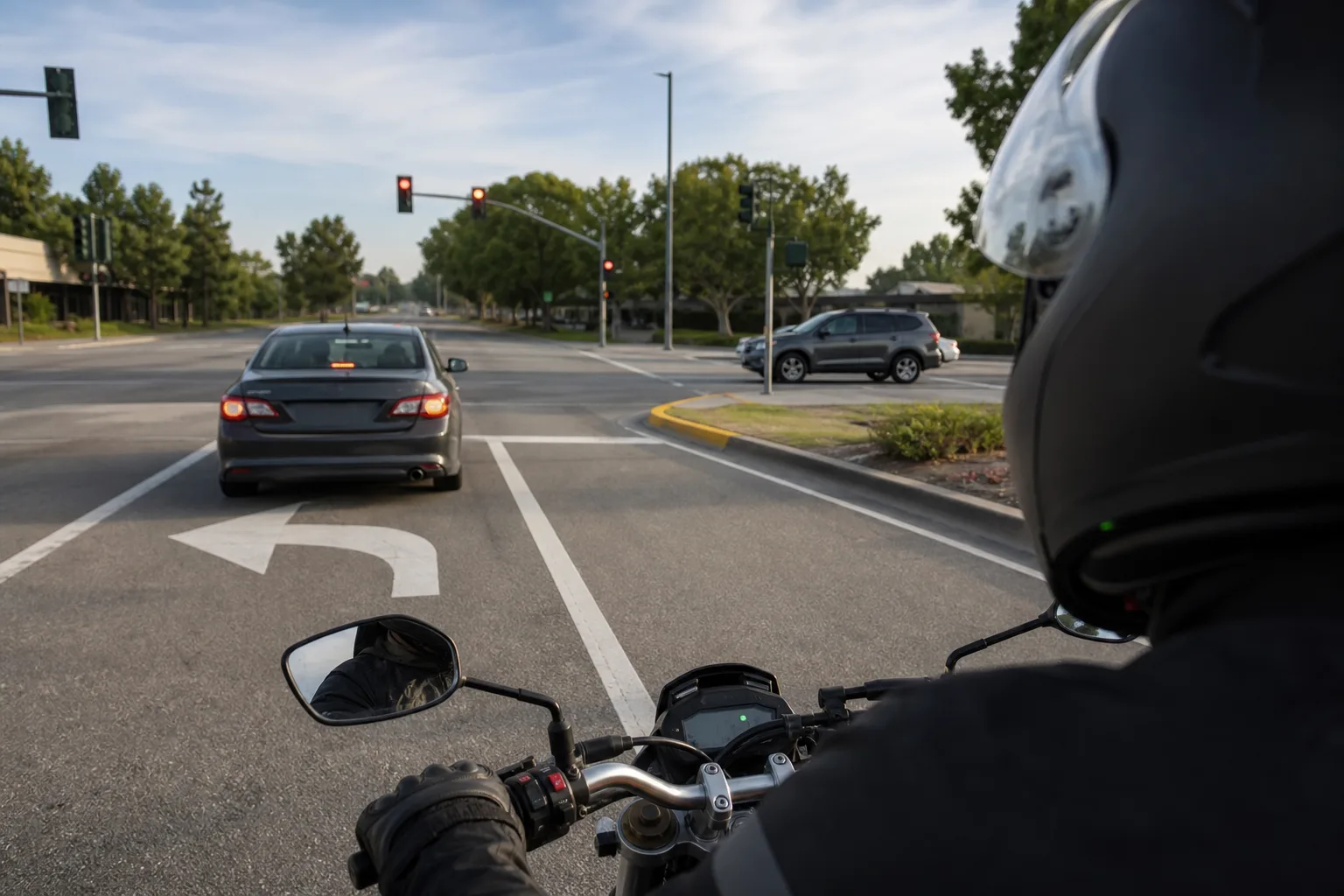
The safest intersection decision usually begins before the stop line. Treat an approaching junction as a changing problem rather than a routine straight-ahead ride.
First, identify the conflict zones: oncoming traffic that may turn across you, vehicles waiting at side streets or driveways, cars edging out from visual obstructions, and traffic ahead that could stop unexpectedly. Then ask a simple question: Where could I go if one of those vehicles moves now?
Give yourself time to answer it. Ease off the urge to arrive quickly, leave enough following distance to see around the vehicle ahead where practical, and avoid entering an intersection with no margin for a sudden change. NHTSA advises riders to proceed cautiously at intersections, ride defensively, leave room around other vehicles, and signal before lane changes. 1
Lane position is not a fixed “correct” strip of pavement. Choose the part of your lane that best supports the current view: your view of traffic, traffic’s view of you, and your available space if the situation changes. Reassess when a large vehicle, parked vehicle, curve, shadow, queue, or roadside object blocks the picture.
Use Signals and Movement Deliberately
Signals help other road users interpret what you plan to do, but they are communication—not clearance. Use them for turns and lane changes, then keep watching for the response you need: a vehicle holding position, yielding, or creating a clear path.
Avoid unnecessary last-second changes near an intersection. A predictable line and early, lawful signaling give others more time to process your movement. MSF recommends using turn signals for every turn and lane change, giving motorists time and space to respond, and using lane positioning to see and be seen. 3
Brake-light communication can also matter when you are slowing in traffic. MSF suggests flashing the brake light, where possible, when slowing and before stopping. The point is not to assume the following driver will react; it is to make your deceleration easier to notice while you keep a buffer and remain alert to what is behind you. 3
Keep an Escape Route, Not Just a Hope
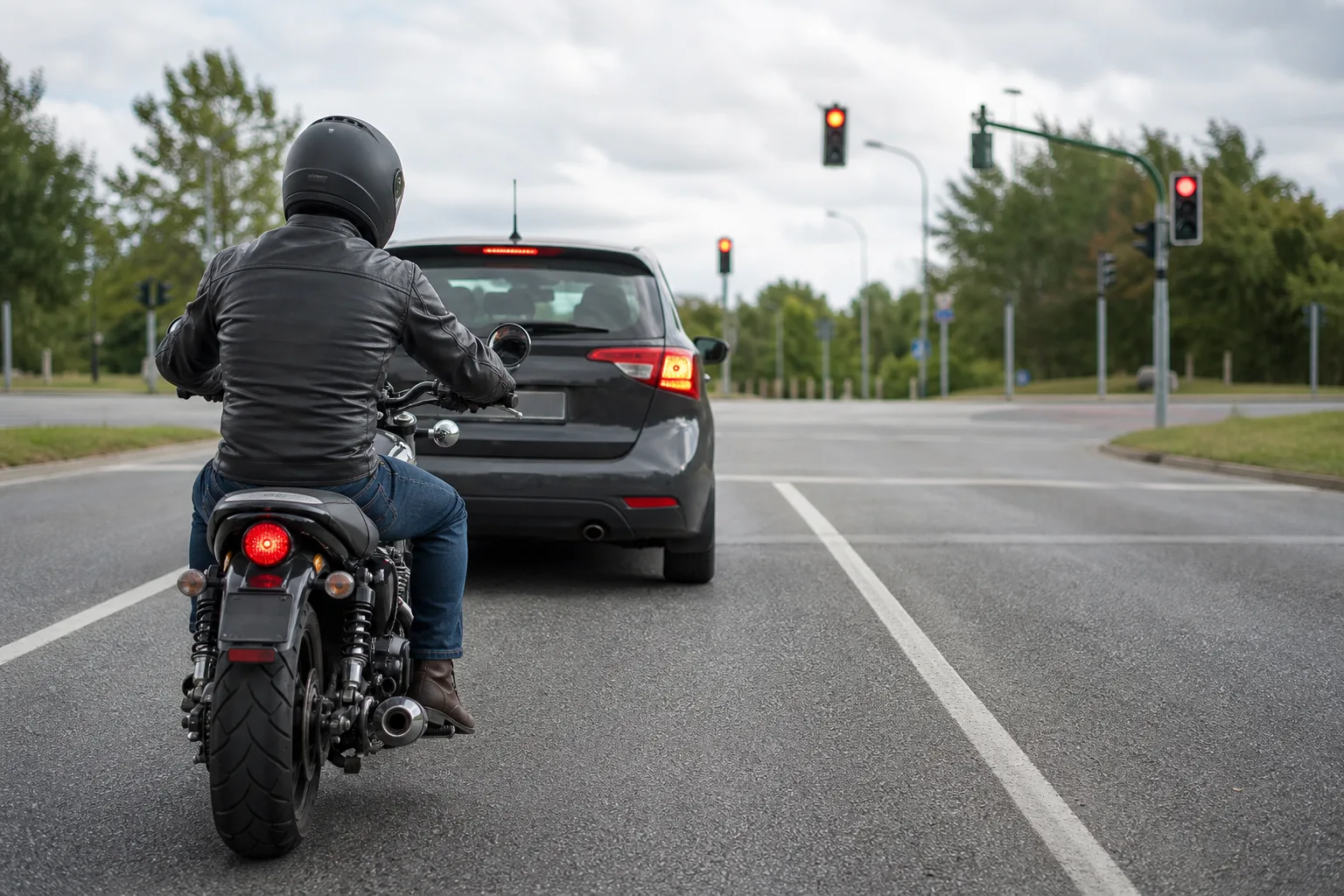
An escape route is a space you have identified before you urgently need it. It may be open pavement ahead, a clear area within your lane, or a direction that preserves separation from a developing conflict. Its value is that it prevents tunnel vision: instead of staring only at the vehicle that might turn, you retain awareness of space around the motorcycle.
Do not treat an escape route as permission to ride faster into uncertainty or to make an abrupt maneuver beyond your skills. It is a contingency, supported by controlled speed, available traction, and room to act. If no reasonable option is visible, the conservative answer is to create one by reducing speed and enlarging your following space.
MSF’s guidance is direct: give yourself time and space while searching for traps and escape paths, and ride as if you are invisible. 3
Intersection Visibility Checklist
Use this short reset before busy junctions, driveway clusters, and turn lanes:
- Lights and signals: Confirm the headlight and indicators are functioning before the ride; follow the owner’s manual for your motorcycle’s normal operation. 1
- Conspicuity: Wear protective gear that also helps you stand out, such as brighter colors or reflective elements when appropriate. [1]2
- Scan: Look for oncoming left turns, side-street traffic, driveway traffic, pedestrians, and stopped or slowing vehicles ahead.
- Position: Select a lane position that improves your view and makes you less likely to linger beside or directly behind another vehicle.
- Space: Preserve room ahead and avoid closing on a vehicle so tightly that you lose your view or options.
- Signal: Communicate turns and lane changes early enough for other road users to respond, then continue to verify the path. 3
- Escape: Identify open space before entering the conflict area; if you cannot identify any, slow down and rebuild margin.
- Mindset: Assume a driver can still miss you, even when you are conspicuous.
For the inspection habits that support a road-ready motorcycle, see the Motorcycle Maintenance Guide.
Review Near Misses Without Blaming Visibility Alone
After a close call, record the intersection layout, traffic movement, signal phase, sight obstructions, lighting, weather, lane position, following gap, speed environment, and the first moment the conflict became visible. Do this after parking safely, not while riding.
Ask what reduced time or space and what earlier choice could have preserved it. A bright jacket or auxiliary light may improve conspicuity, but it cannot force another road user to look, judge speed correctly, or yield. Keep visibility measures while also adjusting approach speed, position, gap, scanning, and escape options.
Use recurring locations as planning data. If one junction repeatedly hides turning vehicles or compresses your escape path, choose a different lane position, time, or route when practical. The goal is not to prove who had the right of way; it is to arrive with more options when another person makes an error.
Review the plan when changing motorcycles. Seating height, mirrors, lighting, acceleration, braking, width, and luggage can alter sight lines and escape options. Repeat familiar routes conservatively until the new motorcycle’s context no longer competes for attention.
How Vojo Helps
Before a regular commute or group ride, create a recurring pre-ride item in the motorcycle maintenance tracker for lights, signal indicators, tires, brakes, and fluid-level checks based on your owner’s manual. After the check, log any concern and defer the ride or arrange appropriate service when a safety-critical item does not pass. That creates a simple record of the basics you depend on before entering complex traffic.
Download Vojo on the App Store
Related Posts
- How to Choose a Reliable Used Motorcycle
- Motorcycle Helmet Safety: Fit, Certification, and When to Replace It
- Pre-Season Motorcycle Maintenance Checklist
Sources
1 National Highway Traffic Safety Administration, Motorcycle Safety: Helmets, Motorists, Road Awareness.
2 National Highway Traffic Safety Administration, Strategies to Increase Rider Conspicuity and Use of Protective Clothing.
3 Motorcycle Safety Foundation, If You Ride A Motorcycle.
Quick answers
Frequently asked questions
Does bright motorcycle gear guarantee that drivers will see me?
No. Bright or reflective equipment can improve conspicuity, but it cannot guarantee that a driver is looking, recognizes your path, or yields. Treat it as one layer in a defensive intersection plan.
Should I use my motorcycle headlight during the day?
NHTSA advises riders to keep motorcycle headlights on at all times to improve visibility. Confirm normal operation using your owner’s manual and address a lighting fault before relying on the motorcycle in traffic.
What is the most important risk to scan for at an intersection?
Scan broadly rather than fixating on one threat. Give special attention to vehicles that may turn across your path, vehicles entering from side streets or driveways, and traffic ahead that may stop.
What does an escape route mean for motorcycle riders?
It means identifying usable open space before a conflict develops, rather than discovering too late that you have nowhere to go. If you cannot identify reasonable space, reduce speed and create more margin.
Is one lane position always safest at an intersection?
No. Lane position should respond to the view, nearby vehicles, roadway layout, and available space. Use the position that best helps you see, be seen, and retain options in that moment.