
Motorcycle Battery Storage: Maintainer Versus Charger, Temperature, and the Model-Manual Check
Motorcycle battery storage is not one-size-fits-all. Compare maintainers and chargers, consider temperature and loads, then check your model manual.
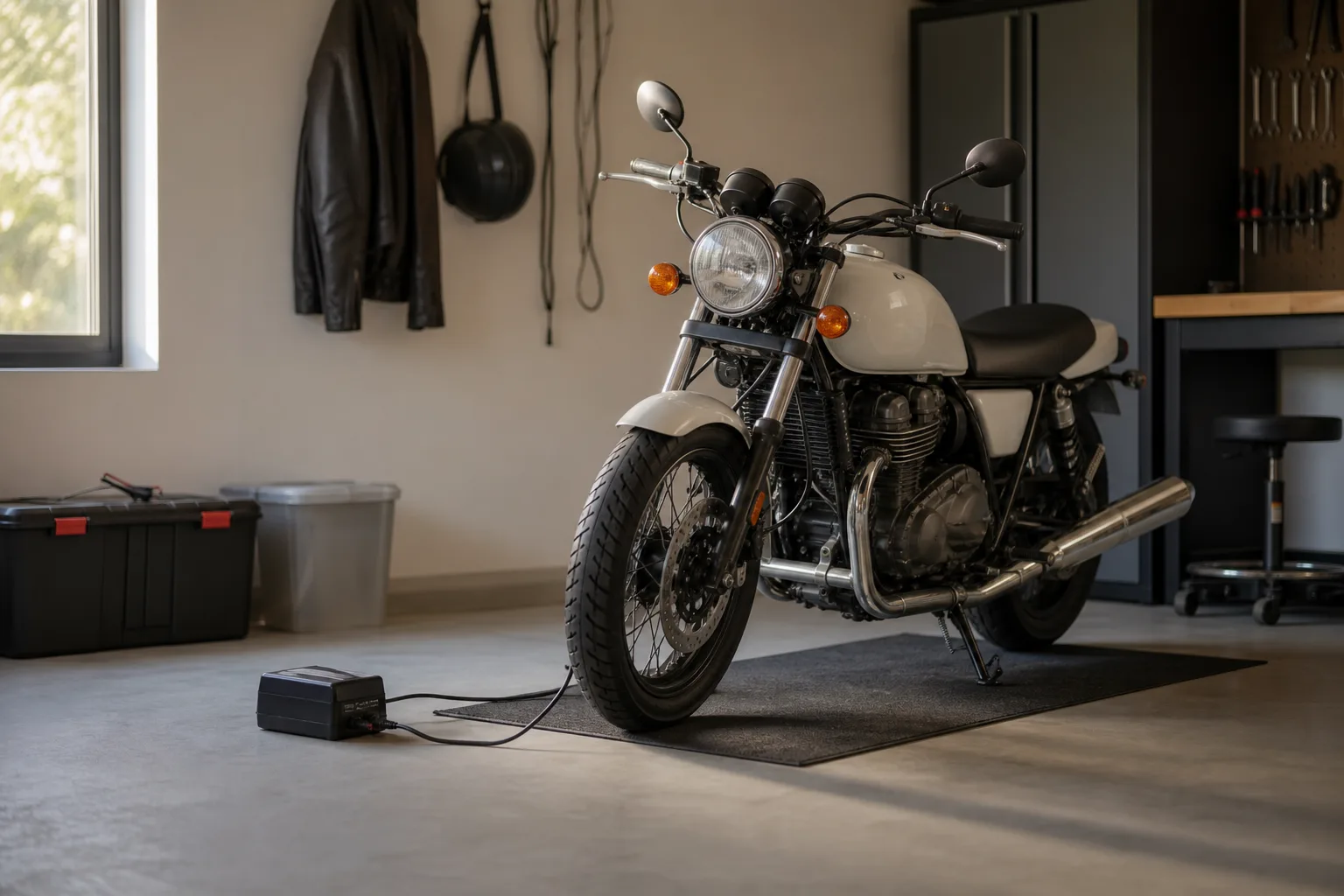
Fact-checked against cited official documentation
Reviewed against Harley-Davidson owner and storage documentation on battery self-discharge, storage conditions, and automatic constant-monitoring charging equipment, plus current manufacturer charging guidance..
Last updated September 23, 2026
A motorcycle battery maintainer and a charger can both be useful before storage, but they are not interchangeable by default. The right choice depends on the battery chemistry, the motorcycle’s documented charging guidance, any accessory draw, the storage environment, and the condition of the battery when you park it.
Start with the owner’s manual for the exact motorcycle and the instructions supplied with the battery and charging device. That matters especially if the bike has a replacement battery, an added security system, or accessories connected directly to the battery.
Maintainer vs. charger: choose the job first
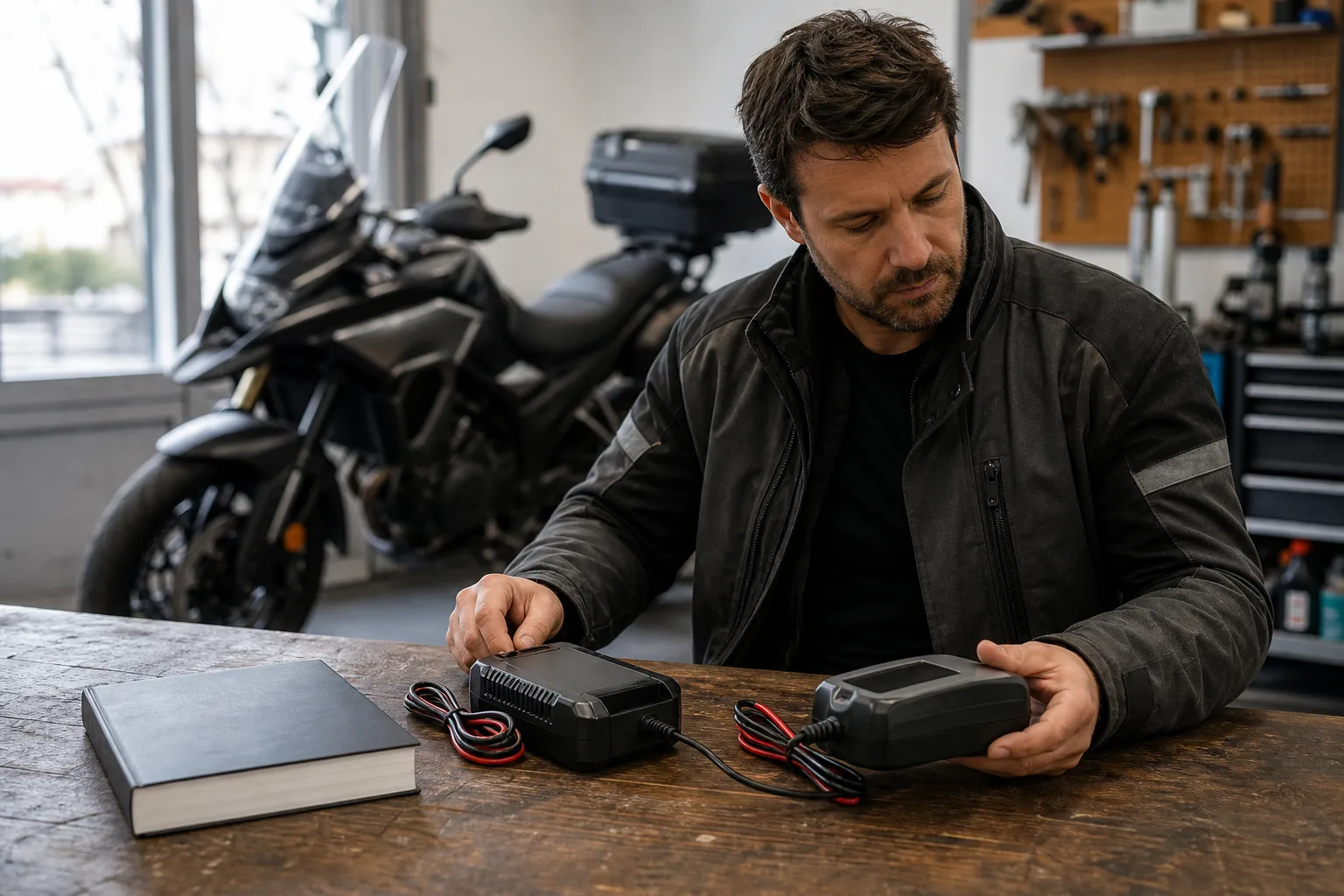
A charger is for restoring charge when a battery needs it. A maintainer is intended to monitor an already serviceable battery and keep it at an appropriate stored state over time. Many modern smart units perform both roles, but only when their settings and compatibility match the battery.
Harley-Davidson’s current guidance illustrates why labels alone are not enough: it distinguishes automatic, constant-monitoring equipment from constant-current charging approaches for its AGM batteries, and it directs owners to use equipment suited to the battery type. Treat that as a model-specific example—not a universal setting for every motorcycle.
| Storage question | What to confirm | Safer decision |
|---|---|---|
| Is the battery healthy and charged? | Manual, battery condition, and any warning signs | Use the documented storage plan; do not assume a maintainer will correct a damaged battery. |
| What chemistry is fitted? | The battery label and motorcycle documentation | Choose a device and mode explicitly approved for that chemistry. |
| Is storage more than a brief pause? | Your manual’s storage guidance and the bike’s parasitic loads | Consider the manufacturer-approved maintenance method rather than leaving the battery unattended. |
| Is the device only a basic charger? | Device instructions and automatic-monitoring capability | Do not treat it as a long-term maintainer unless its instructions explicitly permit that use. |
| Has the battery been replaced or modified? | Battery-maker instructions and accessory documentation | Re-check compatibility; the original-bike manual may no longer describe the installed battery. |
Manufacturer-first safety guidance: Never improvise battery charging equipment, use a mode not specified for the installed chemistry, or continue with a battery that is leaking, visibly deformed, damaged, or behaving abnormally. Stop and follow the motorcycle and battery manufacturer’s instructions; use qualified service when their guidance calls for it.
Temperature and storage location

Temperature changes the storage conversation. Harley-Davidson owner documentation notes that self-discharge rises with temperature and treats storage conditions as part of battery care. A hot, poorly ventilated space can therefore be a poor place to leave a motorcycle battery unmanaged. Conversely, cold storage does not make all batteries or all charging devices behave the same way.
The practical answer is not a universal garage temperature. It is to keep the motorcycle in a location allowed by its documentation, protect the battery from conditions the manufacturer warns against, and confirm that the charger or maintainer is approved for the expected environment. If the space is damp, exposed to large swings in temperature, or lacks a safe power setup, reassess the plan instead of routing an extension cord and hoping for the best.
A temperature-compensating feature may be relevant on some charging products, but it does not override the motorcycle manual, battery label, or device instructions.
The model-manual check before layup
Before connecting anything, make a short record of what is actually on the bike:
- Identify the battery. Read the label for chemistry and any charging restrictions. Do not rely on the original specification if the battery has been replaced.
- Read the storage section of the owner’s manual. Look for its stated approach to battery preservation, security systems, removal or connection points, and storage duration.
- Read the charging-device instructions. Confirm chemistry, voltage, operating mode, connection limits, and whether long-term maintenance is expressly allowed.
- Account for installed loads. Alarm systems, trackers, heated-gear leads, USB modules, and aftermarket electronics can change how the motorcycle behaves while parked.
- Inspect before storage. A clean, dry battery area and an undamaged case are basic prerequisites; do not charge a battery with signs of physical damage.
- Set a review date. Storage is not a set-and-forget promise. Revisit the motorcycle, storage area, and device status according to the applicable instructions.
Harley-Davidson’s storage material similarly points owners back to the relevant motorcycle documentation, reinforcing the central rule here: the right battery plan is model-led, not based on a generic “tender” recommendation.
For the wider layup plan—including tires, fluids, controls, and the return-to-road inspection—see the Motorcycle Maintenance Guide.
A practical storage checklist
- Confirm the installed battery’s chemistry from its label.
- Read the motorcycle owner’s manual storage and battery sections.
- Check the charger or maintainer instructions for explicit battery compatibility.
- Use the device’s correct approved mode; do not guess from connector fit alone.
- Inspect the battery area for moisture, damage, leaks, swelling, or unusual heat signs.
- Consider accessories and security equipment that may draw power while parked.
- Store the motorcycle where the manufacturer’s environmental and electrical cautions can be met.
- Record the storage date and schedule a documented review.
- Before riding again, complete a broader pre-season inspection rather than judging readiness from a green indicator alone.
When a maintainer is not the answer
A maintainer is not a diagnosis tool. If the battery repeatedly loses charge, the motorcycle has abnormal starting behavior, cables or terminals show damage, or the battery has visible defects, do not mask the issue with continuous charging. The cause may involve the battery, the motorcycle’s charging system, an accessory load, or a connection problem. Follow the manufacturer’s diagnostic guidance or arrange qualified inspection.
Likewise, do not assume that a battery removed from the motorcycle can be treated with a different charging method. Its chemistry and the device instructions still govern the decision.
Build a Storage Plan Around the Battery Type
Before connecting equipment, identify the installed battery technology and the motorcycle manufacturer’s storage instructions. Do not infer chemistry from case shape or a seller listing. The charger or maintainer must explicitly support the battery, its voltage, and the required charging profile. Vehicle electronics and accessory connections may add model-specific restrictions.
| Planning item | Confirm from documentation | Stop if |
|---|---|---|
| Battery identity | Type, voltage, capacity, installation and safety guidance | Labels are missing or the installed battery is uncertain |
| Charging equipment | Supported chemistry, operating mode, lead connection, environment | The device is damaged, incompatible, or becomes abnormally hot |
| Storage location | Ventilation, temperature, moisture, ignition sources, cable protection | The location conflicts with battery or charger instructions |
| Motorcycle connection | Approved connector, fuse, polarity, parasitic loads | Wiring is modified, unfused, loose, or heat-damaged |
Inspect the Whole Arrangement Periodically
Automatic operation does not mean “connect and forget.” Follow the equipment instructions for inspection. Check for cable damage, loose or corroded terminals, swelling, leakage, odor, excessive heat, error indicators, moisture, and anything that could pull on or crush the leads. Keep the area clear and do not cover equipment in a way that defeats required ventilation.
If the device reports a fault or repeatedly returns to an unexpected state, disconnect it only as instructed and investigate the battery, connection, and equipment. Repeatedly resetting a fault is not maintenance. A battery that will not accept or retain charge may need professional testing and replacement.
Plan the Return to Service
Before the first ride, remove the charging equipment and restore protective caps, covers, cable routing, and seat or bodywork exactly as required. Confirm terminal security, inspect for leakage or damage, and follow the motorcycle’s startup guidance. Watch the normal warning-light sequence and do not assume a successful start proves the battery and charging system are healthy.
Record storage start and end dates, battery type and age, equipment used, unusual indications, test results, and any replacement. This history helps explain future starting or charging issues and prevents the next storage season from beginning with an unknown battery baseline.
How Vojo Helps
Create a storage event in the motorcycle maintenance tracker, attach the battery chemistry and charger-mode notes from your manual, then set a dated reminder to inspect the storage setup and complete your pre-ride return-to-service check. That gives you a record of what was connected, what the manual required, and what you observed when the motorcycle comes back into use.
Quick answers
Frequently asked questions
Is a motorcycle battery maintainer better than a charger for storage?
Neither is automatically better. A charger may be appropriate when the battery needs charging, while a compatible automatic maintainer may be appropriate for ongoing storage. Follow the motorcycle manual, battery label, and device instructions.
Can I leave a motorcycle battery maintainer connected all winter?
Only if the motorcycle, installed battery, and specific device documentation allow that arrangement. A device’s connector fitting the bike does not establish chemistry or long-term-use compatibility.
Does cold weather mean I should keep the battery on a charger?
Not by itself. Temperature is one part of the storage decision. Confirm the approved storage environment and charging guidance for both the battery and the device rather than applying one rule to every garage.
Do I need a different charger for an AGM and a lithium motorcycle battery?
Possibly. Battery chemistry is a primary compatibility check. Use a charger or maintainer only when its instructions explicitly support the battery installed in your motorcycle and its selected mode.
Can a maintainer fix a battery that keeps going flat?
No. Repeated discharge, poor starting, damaged connections, or a visibly compromised battery should be investigated under manufacturer guidance. Continuous charging can conceal rather than resolve the underlying problem.